
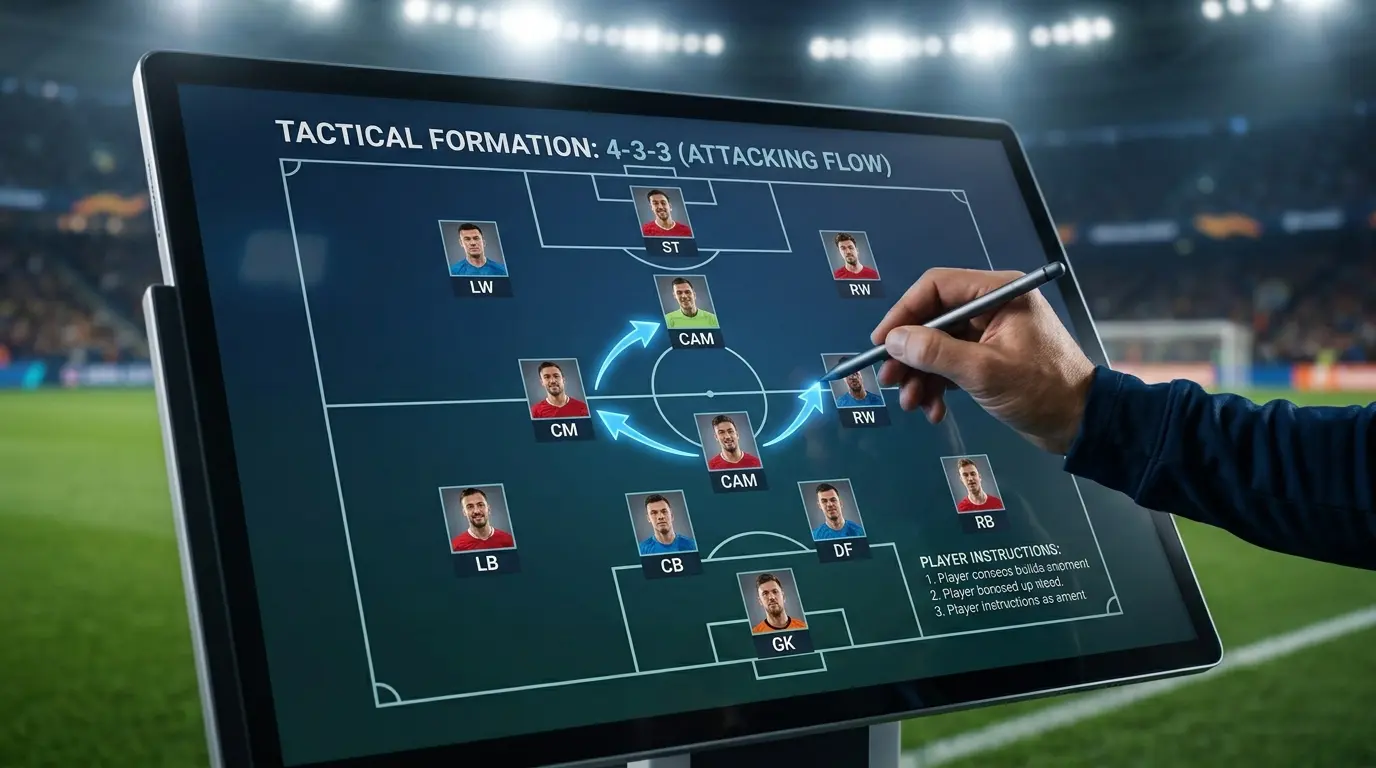
Watch any soccer match and you will notice players spread across the pitch in specific areas, some defending deep, some controlling the middle, some pushing forward to attack.
These are not random positions. Every player on the pitch has a defined role with specific responsibilities. Understanding those roles transforms how you watch the game, suddenly every movement, every run, every pass has context and meaning.
This guide explains every soccer position, what it is called, where on the pitch it operates, what the player in that role is responsible for, and what skills make a great player in that position.
How Soccer Positions Are Organised
Soccer positions are organised into four layers on the pitch:
| Layer | Positions | Primary Job |
|---|---|---|
| Goalkeeper | GK | Stop the ball entering the goal |
| Defenders | CB, LB, RB, LWB, RWB | Prevent the opposition from scoring |
| Midfielders | CM, DM, AM, LM, RM | Control the game and connect defence to attack |
| Forwards | ST, CF, LW, RW | Score goals and create chances |
Each position has a standard abbreviation used in team sheets, video games, and broadcast graphics worldwide. We will cover all of them here.
The Goalkeeper (GK)
Where They Play
The goalkeeper operates in and around their own penalty area. They are the last line of defence, stationed in front of the goal.
Primary Responsibilities
- Stop shots from entering the goal
- Organise the defensive line in front of them
- Distribute the ball accurately to teammates after making a save or receiving a back pass
- Come off their line to claim crosses and through balls
- Command their penalty area with authority
Key Skills
- Reflexes — the ability to react instantly to shots from close range
- Positioning — always being in the right place to narrow angles
- Communication — constantly directing defenders and calling for the ball
- Distribution — throwing, rolling, or kicking the ball accurately to start attacks
- Aerial ability — winning headers and catching or punching crosses
What Makes a Great Goalkeeper
A great goalkeeper does not just make spectacular saves, they prevent situations from becoming dangerous in the first place through smart positioning. They are also increasingly important with the ball at their feet, as modern soccer demands goalkeepers who can play out from the back.
Famous examples: Manuel Neuer (Germany), Gianluigi Buffon (Italy), Iker Casillas (Spain)
Defenders
Defenders form the back line of the team. Their primary job is to prevent the opposition from creating and converting goalscoring opportunities.
There are five main defensive positions:
Centre-Back (CB)
Also called: Central defender, centreback
Where They Play
Centre-backs play in the middle of the defensive line, directly in front of their own goal. Most teams play with either two or three centre-backs.
Primary Responsibilities
- Win aerial duels and headers from crosses and set pieces
- Tackle opponents who break through the midfield
- Block shots and interceptions
- Organise the defensive shape of the whole team
- Carry the ball out from the back when possible
Key Skills
- Heading — winning aerial battles is fundamental
- Tackling — clean, well-timed challenges to win the ball
- Positional awareness — reading where danger will come from before it arrives
- Composure — staying calm under pressure near their own goal
- Leadership — centre-backs often captain their teams
Famous examples: Virgil van Dijk (Netherlands), Sergio Ramos (Spain), Franz Beckenbauer (Germany)
Left-Back (LB) and Right-Back (RB)
Also called: Full-backs
Where They Play
Full-backs play on the left and right sides of the defensive line. They are responsible for their respective flanks, defending wide areas and supporting attacks down the wings.
Primary Responsibilities
- Stop opposing wingers from crossing the ball
- Support their own wingers and midfielders in attack
- Track runs from opposition players overlapping down the wings
- Deliver crosses when pushing forward
- Provide width to the team’s shape
Key Skills
- Speed and stamina — full-backs cover enormous distances up and down the flank every match
- Defensive discipline — knowing when to attack and when to stay back
- Crossing — delivering accurate balls into the box when overlapping
- One-on-one defending — holding their ground against quick wingers
Famous examples: Trent Alexander-Arnold (England), Andrew Robertson (Scotland), Cafu (Brazil)
Wing-Backs (LWB and RWB)
Wing-backs are essentially full-backs given much more attacking freedom. They are used in formations with three centre-backs (like 3-4-3 or 5-3-2) where the centre-backs provide enough defensive cover to allow the wide players to push much higher up the pitch.
Wing-backs are expected to function almost like wide midfielders, getting forward frequently to create chances while also tracking back to defend.
Famous examples: Achraf Hakimi (Morocco), Marcos Alonso (Spain)
Midfielders
The midfield is the engine room of any soccer team. Midfielders connect defence and attack, control possession, cover ground all over the pitch, and are often the most tactically complex players on the field.
There are five main midfield positions:
Central Midfielder (CM)
Where They Play
Central midfielders operate in the middle third of the pitch. They are the most versatile players on the field, involved in both defending and attacking phases of play.
Primary Responsibilities
- Win possession and recycle the ball quickly
- Create passing lanes and support both defenders and forwards
- Cover ground and be available for the ball constantly
- Score goals from midfield runs and set pieces
- Press opponents when the team is out of possession
Key Skills
- Passing range — able to play short passes to keep possession and long passes to switch play
- Vision — seeing options before receiving the ball
- Work rate — covering the most ground of any outfield position
- Technique — controlling the ball cleanly under pressure
- Tactical intelligence — understanding when to press, when to hold, when to run
Famous examples: Xavi Hernandez (Spain), Andrea Pirlo (Italy), Luka Modric (Croatia)
Defensive Midfielder (DM)
Also called: Holding midfielder, “the six”
Where They Play
The defensive midfielder sits in front of the back four, acting as a shield for the defence. They rarely push into attacking areas and instead focus on protecting space, breaking up opposition attacks, and distributing the ball simply.
Primary Responsibilities
- Intercept passes aimed at breaking through the midfield
- Win tackles and headers in the centre of the pitch
- Screen the defensive line from opposition attackers
- Distribute the ball simply and safely after winning possession
- Drop between centre-backs to help build play from the back
Key Skills
- Anticipation — reading the game to intercept passes before they reach their target
- Tackling — winning the ball cleanly and often
- Composure under pressure — controlling possession in tight spaces
- Positioning — always being in the right place to cut passing lanes
Famous examples: Claude Makelele (France), Sergio Busquets (Spain), N’Golo Kanté (France)
Attacking Midfielder (AM)
Also called: Number 10, playmaker, “the ten”
Where They Play
The attacking midfielder operates between the opposition’s midfield and defensive lines, finding pockets of space to receive the ball and create chances for the forwards.
Primary Responsibilities
- Create goalscoring opportunities for strikers
- Deliver key passes through tight defensive lines
- Score goals from midfield positions
- Link midfield and attack with quick, intelligent passing
- Draw defenders out of position to create space for others
Key Skills
- Creativity — seeing passes others cannot
- Technical ability — controlling the ball instantly under pressure
- Decision-making — knowing when to pass, shoot, or dribble
- Goal threat — regularly arriving in dangerous positions to score
- Dribbling — beating defenders in tight spaces
Famous examples: Lionel Messi (Argentina), Zinedine Zidane (France), Ronaldinho (Brazil)
Left Midfielder (LM) and Right Midfielder (RM)
Also called: Wide midfielders
Wide midfielders operate on the flanks of the midfield, combining the defensive duties of a full-back with the attacking output of a winger. They are expected to track back and help defend while also getting forward to deliver crosses and create chances.
Forwards
Forwards are the attacking players closest to the opposition goal. Their primary job is to score — though modern forwards are also expected to press defenders and create space for teammates.
Striker (ST)
Also called: Centre-forward, number 9
Where They Play
The striker plays highest up the pitch, as close to the opposition goal as possible. They are the focal point of the attack and the player most expected to score goals.
Primary Responsibilities
- Score goals — this is the primary and most important job
- Hold up the ball to bring teammates into play
- Press opposition centre-backs and force mistakes
- Create space for attacking midfielders with intelligent movement
- Win headers from crosses and set pieces
Key Skills
- Finishing — converting chances cleanly with both feet and head
- Movement — finding space in crowded penalty areas
- Strength — holding off defenders when receiving the ball with back to goal
- Composure — staying calm when one-on-one with the goalkeeper
- Aerial ability — winning headers from crosses
Famous examples: Cristiano Ronaldo (Portugal), Erling Haaland (Norway), Ronaldo (Brazil)
Centre-Forward (CF)
The centre-forward is a more creative variation of the striker. Rather than playing as a pure goal scorer, the centre-forward drops deeper to link play and create chances for others, while still being a consistent goal threat themselves.
Famous examples: Karim Benzema (France), Roberto Firmino (Brazil)
Left Winger (LW) and Right Winger (RW)
Where They Play
Wingers play on the far left and right edges of the attacking line. They use pace and dribbling ability to beat defenders on the outside and deliver crosses, or cut inside onto their stronger foot to shoot at goal.
Primary Responsibilities
- Take on and beat defenders in one-on-one situations
- Deliver crosses into the box for the striker
- Cut inside to shoot or create chances
- Track back to help defend when the team loses possession
- Stretch the opposition defensive line to create space in the middle
Key Skills
- Pace — speed to get behind defenders
- Dribbling — ability to beat opponents with skill moves and quick feet
- Crossing — delivering accurate balls into the box
- Shooting — scoring from wide positions or cutting inside
Famous examples: Kylian Mbappé (France), Lionel Messi (Argentina), Gareth Bale (Wales)
How Positions Change With Different Formations
The positions players occupy change depending on the team’s formation. Here are the three most common formations and how they affect positions:
4-3-3
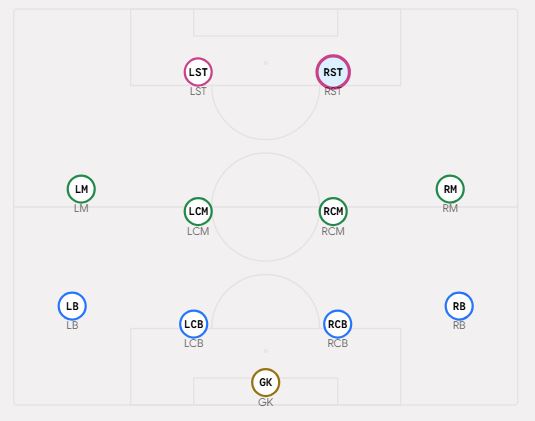
Three forwards with three central midfielders and a flat back four. Wingers are very important.
4-4-2
Two strikers supported by four midfielders. Classic traditional formation, less common at top level today.
4-2-3-1
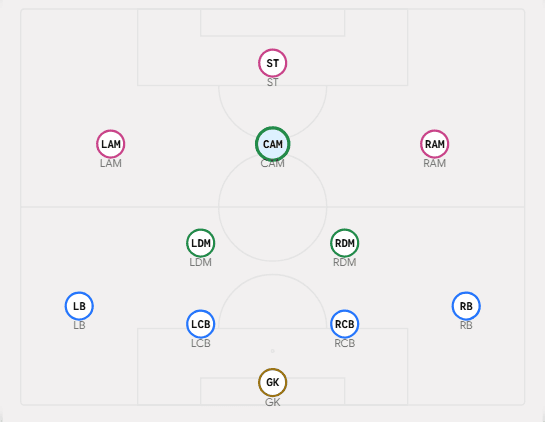
One striker, one attacking midfielder, two defensive midfielders. The most popular formation in modern professional soccer.
Quick Reference: All Soccer Positions
| Abbreviation | Position | Layer |
|---|---|---|
| GK | Goalkeeper | Goalkeeper |
| CB | Centre-Back | Defence |
| LB | Left-Back | Defence |
| RB | Right-Back | Defence |
| LWB | Left Wing-Back | Defence/Midfield |
| RWB | Right Wing-Back | Defence/Midfield |
| DM | Defensive Midfielder | Midfield |
| CM | Central Midfielder | Midfield |
| AM | Attacking Midfielder | Midfield |
| LM | Left Midfielder | Midfield |
| RM | Right Midfielder | Midfield |
| LW | Left Winger | Forward |
| RW | Right Winger | Forward |
| CF | Centre-Forward | Forward |
| ST | Striker | Forward |
Frequently Asked Questions
What is the hardest position in soccer?
Most soccer analysts consider the goalkeeper the hardest position, one mistake can directly cost a goal and the psychological pressure is unique. Among outfield positions, the defensive midfielder is often considered the most demanding tactically.
What position scores the most goals?
Strikers and centre-forwards score the most goals. However, attacking midfielders and wingers also contribute heavily, and in modern soccer many goals come from unexpected positions including full-backs and central midfielders.
What position runs the most in a soccer match?
Central midfielders typically cover the most ground, often running between 12 and 14 kilometres per match. Full-backs also cover enormous distances due to their up-and-down role on the flanks.
What is the number 10 position in soccer?
The number 10 shirt is traditionally worn by the attacking midfielder, the team’s creative playmaker. It is one of the most prestigious shirt numbers in soccer, historically worn by legends like Pelé, Diego Maradona, Zinedine Zidane, and Lionel Messi.
Can players switch positions during a match?
Yes. Managers sometimes move players to different positions during a match for tactical reasons, especially after a substitution changes the team’s shape. Some players are naturally versatile and can play multiple positions comfortably.