
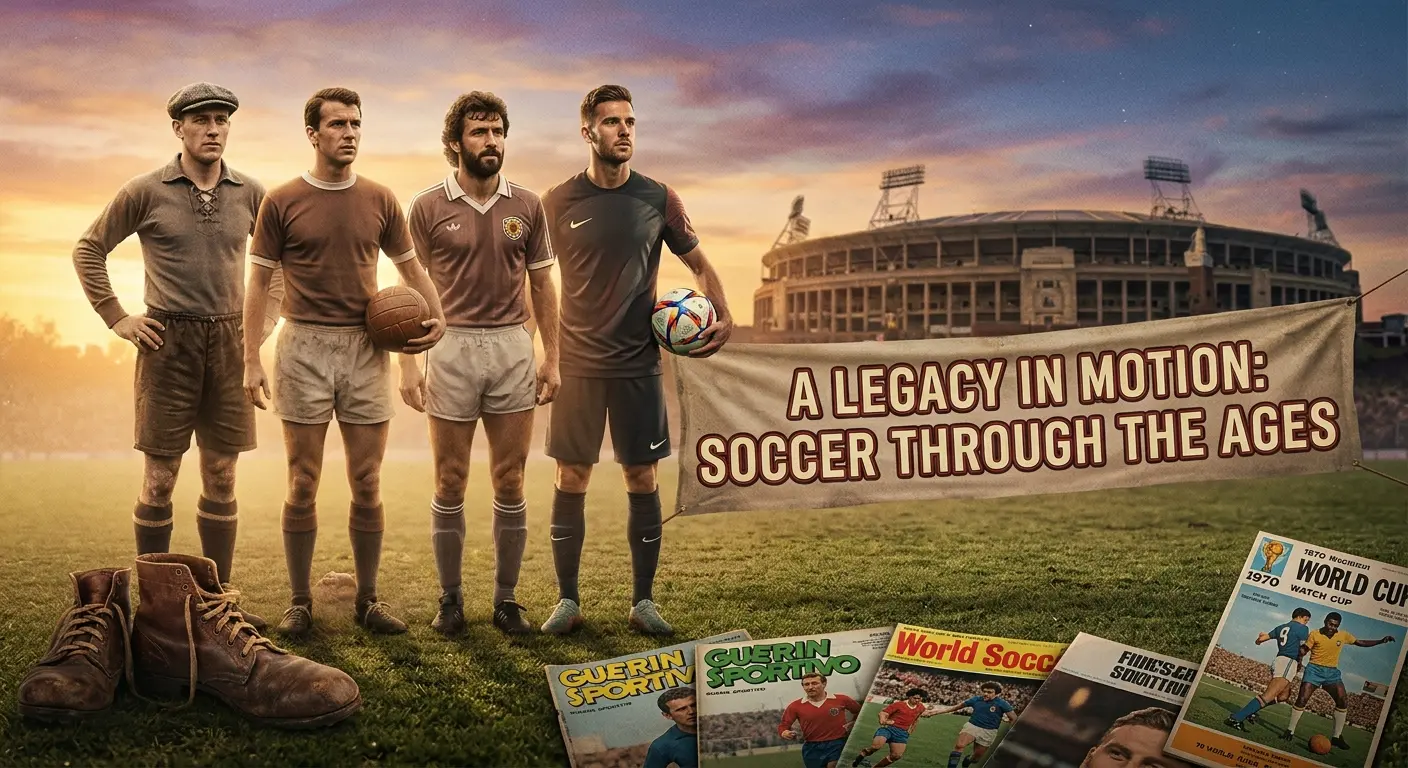
Soccer is more than a sport. It is the most widely played and watched game in human history, followed by over 4 billion people across every continent on earth.
But where did it come from? Who invented it? And how did a simple game of kicking a ball evolve into a trillion-dollar global industry?
The history of soccer stretches back over 2,000 years — through ancient civilizations, medieval village games, Victorian England, and two World Wars — to become the sport we love today.
This is the complete story.
Ancient Origins: 2,000 BC to 1800s
China — The Earliest Known Ball Game
The earliest recorded form of a ball game resembling soccer dates back to Han Dynasty China around 200 BC. The game was called Cuju — which literally translates to “kick ball.”
Cuju was played with a leather ball stuffed with feathers and hair. Players had to kick the ball through a small opening in a net stretched between two poles. Hands were not allowed. The game was used to train soldiers and was also played for entertainment at the imperial court.
FIFA — the world governing body of soccer — officially recognizes Cuju as the earliest form of the game.
Greece and Rome
Ancient Greeks played a game called Episkyros, which involved both hands and feet. The Romans adapted this into a game called Harpastum — a fast, physical game played on a rectangular field with a small ball.
Roman soldiers brought Harpastum across Europe as they expanded their empire, planting early seeds of ball-playing culture across the continent.
Medieval England — Mob Football
In medieval England from around the 8th century onwards, a chaotic game called mob football was played in villages and towns. There were almost no rules. Entire villages competed against each other — sometimes hundreds of players on each side — trying to kick or carry a ball to a target point in the opposing town.
Games were often violent and destructive. Streets were damaged, injuries were common, and the game was banned multiple times by English kings including Edward II in 1314 and Edward III in 1363 — describing it as a useless and noisy sport that distracted men from archery practice.
Despite repeated bans, mob football survived and spread throughout England for centuries.
The Birth of Modern Soccer: 1800s England
Public Schools and the First Rules
The transformation of soccer from a chaotic street game into an organised sport happened in 19th century English public schools. Schools like Eton, Harrow, Rugby, and Winchester each played their own version of football — and when students from different schools tried to play against each other, the lack of common rules caused constant disputes.
Each school started writing down their own rules. Crucially, this is where the first major split in the game occurred:
- Some schools allowed players to pick up the ball and run with it — this eventually became rugby football
- Other schools insisted the ball could only be kicked — this became association football, or soccer

1863 — The Football Association is Founded
The defining moment in soccer history came on 26 October 1863 in London. Representatives from several clubs met at the Freemasons’ Tavern in Covent Garden to form the world’s first football governing body — The Football Association (FA).
At this meeting they agreed on a single set of rules for the game. These rules banned carrying the ball with hands (except for the goalkeeper) and banned tripping and hacking opponents.
This date — October 26, 1863 — is widely considered the birth of modern soccer.
The word “soccer” itself comes from this moment. “Association Football” was informally abbreviated to “assoc” by English university students, which was then further shortened and modified to “soccer” — using the Oxford suffix “-er” that was popular slang at the time.
The First International Match — 1872
The world’s first international soccer match was played on 30 November 1872 in Glasgow, Scotland between England and Scotland. The match ended 0-0 but drew a crowd of approximately 4,000 people — an enormous number for the time.
This match launched international football as a concept and began one of sport’s oldest and most passionate rivalries.
Soccer Spreads Across the World: Late 1800s to Early 1900s
British Sailors and Workers Export the Game
Soccer spread globally thanks largely to British sailors, merchants, and workers who travelled the world during the height of the British Empire in the late 19th century.
Wherever British workers went — South America, Africa, Asia, Europe — they brought soccer with them. Local populations embraced the game and it quickly took root in every corner of the world.
- Brazil — British railway workers introduced soccer in the 1890s. Brazil went on to become the most successful nation in World Cup history
- Argentina — British immigrants formed the first clubs in the 1860s and 1870s
- Spain — British miners in Bilbao helped found Athletic Club, one of Spain’s oldest clubs
- Italy — British expats introduced the game in the 1890s, leading to the formation of clubs like Genoa and AC Milan
The First Club Competitions
As the game spread, clubs began competing against each other in organised competitions:
- 1871 — The FA Cup was founded, becoming the world’s oldest national football competition
- 1888 — The Football League was founded in England, becoming the world’s first professional football league
- 1900 — Soccer was included in the Olympic Games for the first time at the Paris Olympics
FIFA and the World Cup — 1904 to 1938
FIFA is Founded — 1904
As soccer grew internationally, a global governing body was needed. FIFA (Fédération Internationale de Football Association) was founded on 21 May 1904 in Paris by representatives from France, Belgium, Denmark, the Netherlands, Spain, Sweden, and Switzerland.
England — ironically — was not a founding member, though the FA joined later that year. Today FIFA has 211 member associations — more member nations than the United Nations.
The First FIFA World Cup — 1930
The greatest event in soccer history was born in 1930 in Uruguay. The first FIFA World Cup was hosted by Uruguay, which had won the Olympic football gold medals in 1924 and 1928.
Thirteen nations participated. Uruguay beat Argentina 4-2 in the final to become the first ever World Cup champions in front of a crowd of approximately 68,000 people in Montevideo.
The World Cup immediately established itself as the defining competition in world soccer — and it has grown into the most watched sporting event on earth, now attracting over 1.5 billion viewers for the final alone.
Early World Cup History
| Year | Host | Winner | Runner-Up | Score |
|---|---|---|---|---|
| 1930 | Uruguay | Uruguay | Argentina | 4-2 |
| 1934 | Italy | Italy | Czechoslovakia | 2-1 |
| 1938 | France | Italy | Hungary | 4-2 |
| 1942 | Cancelled | — | — | World War II |
| 1946 | Cancelled | — | — | World War II |
| 1950 | Brazil | Uruguay | Brazil | 2-1 |
Post-War Soccer — 1950s to 1970s
The Golden Age of Club Soccer
The 1950s and 1960s are often called the golden age of club soccer. This era produced some of the greatest players and most dominant club sides ever seen:
- Real Madrid won the first five European Cups (now Champions League) from 1956 to 1960, featuring legendary players like Alfredo Di Stéfano and Ferenc Puskás
- Brazil won three World Cups in 1958, 1962, and 1970 — with the 1970 side widely considered the greatest national team ever assembled
- Pelé emerged as the world’s greatest player — scoring over 1,000 career goals and winning three World Cups with Brazil
Television Changes Everything
The 1966 World Cup in England was the first to be broadcast in colour television to audiences around the world. This was a turning point. Suddenly hundreds of millions of people who had never attended a match could watch the world’s best players every week.
Television transformed soccer from a live attendance sport into a global broadcast phenomenon — and set the foundation for the commercial explosion that followed.
The Modern Era: 1980s to Today
The Premier League Revolution — 1992
The single most commercially significant moment in modern soccer history was the formation of the Premier League in England in 1992.
Top English clubs broke away from the Football League to form their own competition with a landmark television deal with Sky Sports. This deal — and the ones that followed — completely transformed the economics of soccer:
- The first Premier League TV deal in 1992 was worth £191 million over 5 years
- The current Premier League TV deal (2022-2025) is worth over £5 billion in domestic rights alone
- Global broadcast rights add billions more on top
The Premier League model was copied across Europe — La Liga, Serie A, Bundesliga, and Ligue 1 all modernised and commercialised their structures — creating the era of the global superclub.
Champions League — 1992
The UEFA Champions League replaced the old European Cup in 1992, expanding the competition and rebranding it with a new anthem and format. It quickly became the most prestigious club competition in the world — and today generates over €3.5 billion per season in revenue.
The Greatest Players of the Modern Era
The late 1990s through to today produced arguably the two greatest individual players in soccer history:
Ronaldo (Brazilian) — won two World Cups and was three times FIFA World Player of the Year
Zinedine Zidane — led France to the 1998 World Cup and won three Champions Leagues as Real Madrid manager
Lionel Messi — Eight Ballon d’Or awards, four Champions League titles, and a 2022 World Cup winner with Argentina — widely considered the greatest player of all time
Cristiano Ronaldo — Five Ballon d’Or awards, five Champions League titles, and the all-time top scorer in men’s international football
Women’s Soccer
Women’s soccer has grown dramatically in the modern era. The FIFA Women’s World Cup, first held in 1991, has grown into one of the world’s major sporting events. The 2023 Women’s World Cup in Australia and New Zealand set new viewership records with over 2 billion viewers across all matches.
The United States has been the dominant force in women’s soccer, winning four World Cups (1991, 1999, 2015, 2019).
Soccer Today
Soccer today is the world’s largest sport by almost every measure:
- 4 billion fans globally
- 265 million registered players across 200+ countries
- $50 billion+ global industry
- 1.5 billion viewers for the World Cup final
- Top player salaries exceeding $100 million per year
The 2026 FIFA World Cup — hosted jointly by the United States, Canada, and Mexico — will be the largest ever, featuring 48 teams for the first time, with matches played across 16 cities in three countries.
Soccer continues to grow — particularly in the United States, India, China, and across Southeast Asia — where new generations of fans are discovering the beautiful game for the first time every day.
Key Dates in Soccer History
| Year | Event |
|---|---|
| 200 BC | Cuju played in Han Dynasty China |
| 1314 | King Edward II bans mob football in England |
| 1863 | Football Association founded in London — modern soccer born |
| 1872 | First international match — England vs Scotland |
| 1888 | First professional football league founded in England |
| 1900 | Soccer included in Olympic Games |
| 1904 | FIFA founded in Paris |
| 1930 | First FIFA World Cup held in Uruguay |
| 1966 | First colour TV broadcast of the World Cup |
| 1991 | First FIFA Women’s World Cup |
| 1992 | Premier League and Champions League both launched |
| 2022 | Messi wins World Cup with Argentina — his career’s defining moment |
| 2026 | World Cup hosted by USA, Canada, and Mexico — 48 teams |
Frequently Asked Questions
Who invented soccer?
No single person invented soccer. It evolved over centuries from ancient ball games in China, Greece, and medieval England. The modern game was officially codified in England in 1863 when the Football Association was founded and agreed on a standard set of rules.
Why is it called soccer in America?
The word soccer comes from “association football” — the official name of the game. English students in the 1880s abbreviated “association” to “assoc” and then to “soccer.” While England dropped the word over time, it stuck in the United States and a few other countries.
What country is the best at soccer?
Brazil has the most World Cup wins with five titles (1958, 1962, 1970, 1994, 2002). Germany and Italy have each won four. Argentina won their third in 2022. In women’s soccer, the United States leads with four World Cup titles.
When was the first World Cup?
The first FIFA World Cup was held in Uruguay in 1930. Uruguay won the tournament, beating Argentina 4-2 in the final.
How many countries play soccer?
FIFA has 211 member associations — more than the number of countries in the United Nations. Soccer is truly the most global sport ever played.