
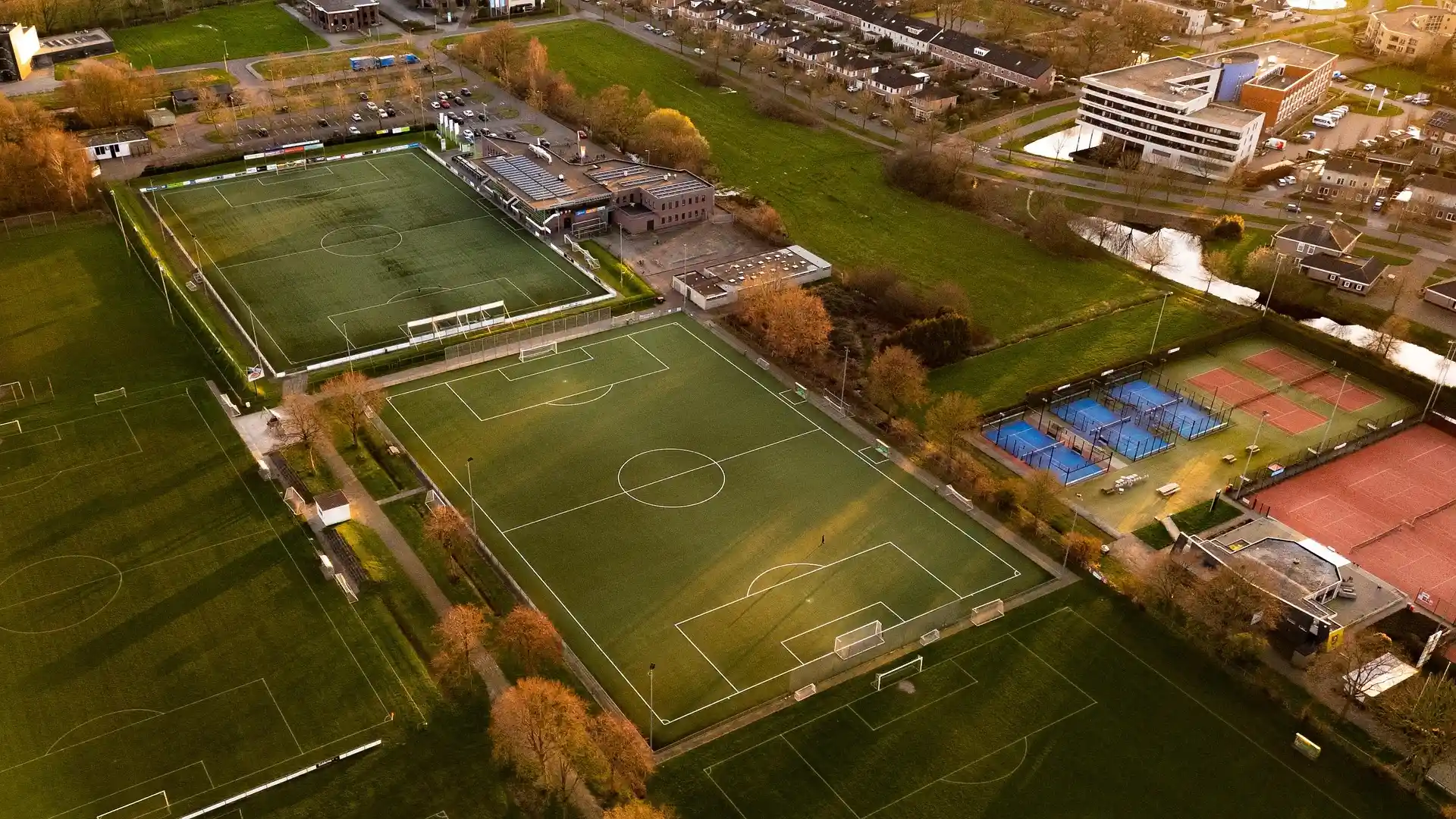
Every soccer match, from a World Cup final watched by billions to a Sunday morning amateur kickabout, is played on a rectangular grass or artificial turf field called a pitch.
But not all soccer fields are the same size. Professional pitches vary significantly from stadium to stadium. Youth pitches are smaller than adult pitches. And indoor soccer is played on an entirely different surface with different dimensions altogether.
Understanding soccer field dimensions helps you appreciate the tactical decisions managers make, why some teams play a high press, why others defend deep, and how the size of the pitch directly affects the style of play.
This guide covers everything you need to know about soccer field dimensions, official measurements, pitch markings, goal sizes, and how it all works in practice.
Official Soccer Field Dimensions: FIFA Standards
FIFA, the world governing body of soccer, sets the official rules for pitch dimensions used in international matches and professional competitions worldwide.
Length and Width
| Measurement | Minimum | Maximum |
|---|---|---|
| Length (touchline) | 100 metres (110 yards) | 110 metres (120 yards) |
| Width (goal line) | 64 metres (70 yards) | 75 metres (80 yards) |
For international matches specifically, FIFA sets tighter requirements:
| Measurement | Minimum | Maximum |
|---|---|---|
| Length | 100 metres (110 yards) | 110 metres (120 yards) |
| Width | 64 metres (70 yards) | 75 metres (80 yards) |
The most common professional pitch size used in top leagues is approximately 105 metres long by 68 metres wide, this has become the unofficial standard for major stadiums around the world.
Why Is There a Range and Not One Fixed Size?
Many new fans are surprised to learn that soccer pitches are not all exactly the same size. Unlike American football where every NFL field is precisely 100 yards long, soccer allows variation within the permitted range.
This means some clubs strategically choose the pitch size that best suits their style of play:
- Larger pitches favour technically skilled teams that like to pass and move, more space means more time on the ball
- Smaller pitches favour physical, pressing teams, less space means less time for the opposition to play out
- Narrow pitches compress the game and make wide play less effective
This is a legitimate tactical consideration that managers account for when preparing for away matches.
All the Lines and Markings: What Each One Means
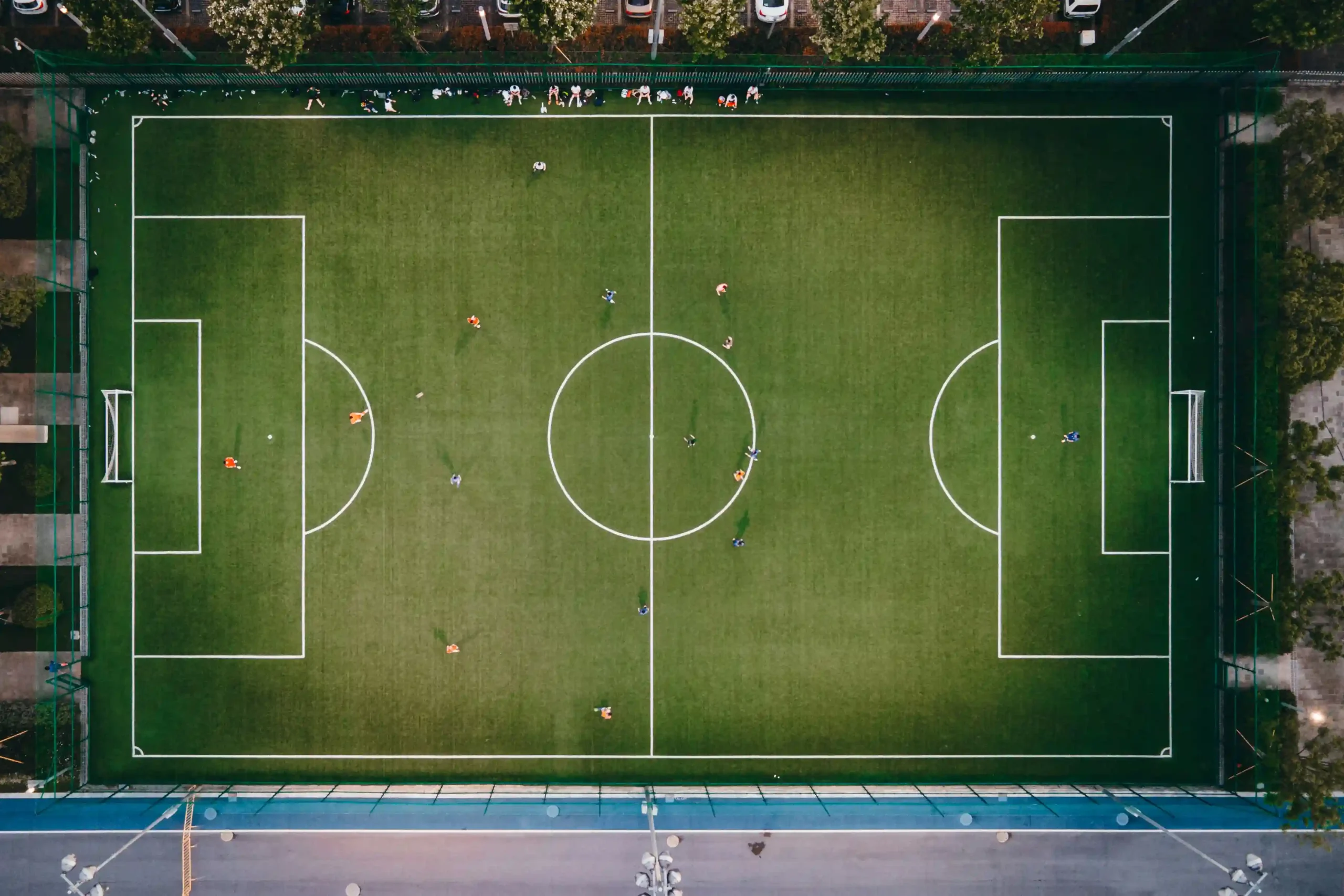
A soccer pitch has a specific set of lines and markings that serve distinct purposes during a match. Here is every marking explained:
The Touchlines (Sidelines)
The two long lines running the length of the pitch on each side are called touchlines or sidelines. When the ball goes out of play over a touchline, a throw-in is awarded to the opposing team.
The Goal Lines (Bylines)
The two short lines running across the width of the pitch at each end are called goal lines or bylines. The goal sits on the goal line at the centre of each end.
- If the attacking team puts the ball out over the goal line, a goal kick is awarded
- If the defending team puts the ball out over their own goal line, a corner kick is awarded
The Halfway Line
A line running across the full width of the pitch at the exact midpoint divides it into two equal halves. Key uses:
- Players must be in their own half at kickoff
- The halfway line determines which half each team defends
- A player cannot be offside in their own half, they must be past the halfway line for offside to apply
The Centre Circle
A circle with a radius of 9.15 metres (10 yards) is marked at the exact centre of the pitch around the centre spot. During a kickoff, all opposition players must remain outside this circle until the ball is kicked.
The Centre Spot
The exact centre of the pitch, where the ball is placed for kickoffs at the start of each half, after a goal is scored, and at the start of extra time periods.
The Penalty Area (The 18-Yard Box)
The penalty area, commonly called the 18-yard box, is the large rectangular box marked in front of each goal. It extends:
- 16.5 metres (18 yards) from each goalpost to the side
- 16.5 metres (18 yards) forward from the goal line
Total width: 40.32 metres (44 yards)
This is one of the most important areas on the pitch. Key rules that apply inside the penalty area:
- The goalkeeper can handle the ball inside their own penalty area
- Any foul by the defending team inside their own penalty area results in a penalty kick for the attacking team
- The goalkeeper must stay on the goal line during a penalty kick until the ball is struck
The Penalty Spot
A small circular mark located 11 metres (12 yards) from the centre of the goal line inside the penalty area. This is where the ball is placed for penalty kicks.
The Penalty Arc
A curved arc extending from the top of the penalty area, marking the point 9.15 metres (10 yards) from the penalty spot. During a penalty kick, all players except the goalkeeper and penalty taker must be both outside the penalty area AND behind this arc until the ball is kicked.
The penalty arc is not part of the penalty area, it simply defines the exclusion zone during penalty kicks.
The Goal Area (The 6-Yard Box)
Inside the penalty area is a smaller rectangular box called the goal area, commonly known as the 6-yard box. It extends:
- 5.5 metres (6 yards) from each goalpost to the side
- 5.5 metres (6 yards) forward from the goal line
Key rules inside the goal area:
- Goal kicks must be taken from within the goal area
- Opponents cannot challenge the goalkeeper inside the goal area when they have the ball in their hands
The Corner Arc
At each of the four corners of the pitch, a small quarter-circle arc with a radius of 1 metre is marked. Corner kicks must be taken from within this arc, the ball must be placed inside or touching the arc line.
Corner flags, small flags on posts, are placed at each corner of the pitch. They must be at least 1.5 metres tall and cannot be removed during play.
The Technical Area
On each side of the halfway line, a rectangular area is marked alongside the touchline. This is the technical area, where the manager, coaching staff, and substitute players must remain during the match.
Managers and coaches can move within this area to give instructions but must return to their designated position once they have done so. Repeated violations result in a warning or expulsion from the technical area.
Goal Dimensions
The goal sits on the goal line at the centre of each end. FIFA specifies exact goal dimensions:
| Measurement | Size |
|---|---|
| Width (post to post) | 7.32 metres (8 yards) |
| Height (ground to crossbar) | 2.44 metres (8 feet) |
| Depth of net | Minimum 1.5 metres at ground level |
Goal posts and crossbar must be:
- White in colour
- Circular, square, or rectangular in cross-section
- Maximum 12 centimetres wide
The net is attached to the goal frame and the ground behind the goal to clearly show when the ball has entered the goal. While nets are not technically required by the laws of the game, they are used in all organised professional matches.
How Pitch Size Varies in Different Competitions
Premier League Pitches
Premier League clubs have some variation in pitch size, and some clubs have historically used this strategically:
| Club | Pitch Length | Pitch Width |
|---|---|---|
| Manchester City (Etihad) | 105m | 68m |
| Liverpool (Anfield) | 101m | 68m |
| Chelsea (Stamford Bridge) | 103m | 67m |
| Arsenal (Emirates) | 105m | 68m |
The differences may seem small but they have real tactical impact. A wider pitch gives more space for wide players and wingers. A narrower pitch compresses the game and makes central play more dominant.
Youth Soccer Field Dimensions
Youth soccer pitches are scaled down to match the age and physical development of younger players. Using full-size pitches for children makes the game harder to learn and less enjoyable.
| Age Group | Pitch Length | Pitch Width | Players |
|---|---|---|---|
| Under 7-8 | 37m | 27m | 5v5 |
| Under 9-10 | 46m | 34m | 7v7 |
| Under 11-12 | 55m | 37m | 9v9 |
| Under 13-14 | 91m | 55m | 11v11 |
| Under 15+ | Full size | Full size | 11v11 |
Futsal and Indoor Soccer Dimensions
Futsal is the official FIFA version of indoor soccer, played on a hard court rather than grass.
| Measurement | Size |
|---|---|
| Length | 25-42 metres |
| Width | 15-25 metres |
| Goal width | 3 metres |
| Goal height | 2 metres |
| Players | 5 per side |
Futsal is played on a much smaller surface with a smaller, heavier ball. The tight spaces develop extraordinary close control and quick thinking, many of the world’s greatest players including Messi, Ronaldo, and Neymar grew up playing futsal.
How Pitch Size Affects Tactics and Playing Style
Understanding pitch dimensions helps explain why different teams play differently, and why the same team might play differently at home versus away.
Large Pitches Favour
- Possession-based teams, more space to pass and move
- Technical players, time and space to control the ball
- High pressing systems, more ground to cover means fitter teams have an advantage
- Wide attacking play, wingers have more room to operate
Small or Narrow Pitches Favour
- Physical, direct teams, less space means quicker vertical play
- Set piece specialists, tighter areas around goal mean more set piece situations
- Defensive teams, less space for the opposition to exploit
- Long ball tactics, bypassing the compressed midfield
Famous Examples of Strategic Pitch Sizing
Several clubs have been noted for adjusting their pitch dimensions to suit their style:
- Swansea City famously played on one of the widest pitches in England to support their pass-and-move style under managers Brendan Rodgers and Michael Laudrup
- Stoke City under Tony Pulis used a notably narrow pitch at the Britannia Stadium to support their direct, physical style and neutralise technically superior opponents
Pitch Surface Types
Natural Grass
The traditional and preferred surface for professional soccer. Natural grass provides the truest ball roll and the most comfortable playing surface, but requires significant maintenance, especially in cold climates or heavily used stadiums.
Artificial Turf (3G/4G)
Modern artificial pitches, called 3G or 4G surfaces, are approved by FIFA for competitive use at certain levels. They require less maintenance than natural grass and perform consistently in all weather conditions. However many professional players find them harder on joints and note that the ball behaves differently compared to natural grass.
Hybrid Grass
A combination of natural grass reinforced with artificial fibres woven into the surface. Used in many top stadiums, including Wembley and many Premier League grounds, hybrid grass offers the feel of natural grass with improved durability.
Complete Soccer Field Diagram
Here is a summary of all key measurements in one place:
| Element | Measurement |
|---|---|
| Pitch length | 100-110 metres |
| Pitch width | 64-75 metres |
| Penalty area length | 16.5 metres |
| Penalty area width | 40.32 metres |
| Goal area length | 5.5 metres |
| Goal area width | 18.32 metres |
| Penalty spot distance | 11 metres from goal |
| Centre circle radius | 9.15 metres |
| Corner arc radius | 1 metre |
| Goal width | 7.32 metres |
| Goal height | 2.44 metres |
Frequently Asked Questions
Are all professional soccer pitches the same size?
No. FIFA allows a range of pitch sizes within set minimums and maximums. Most professional pitches are approximately 105 metres long by 68 metres wide but there is variation between clubs and stadiums.
Why is the penalty area called the 18-yard box?
Because it extends 18 yards from the goal line and 18 yards beyond each goalpost, making the total width 44 yards. The name comes from the original imperial measurements used when the rules were written in England.
How big is a soccer goal compared to other sports?
A soccer goal is 7.32 metres wide and 2.44 metres tall, making it significantly larger than an ice hockey goal (1.83m x 1.22m) but smaller than a field hockey goal (3.66m x 2.14m).
What is the D on a soccer pitch?
The curved arc at the top of the penalty area is called the D or penalty arc. It marks the 9.15-metre exclusion zone from the penalty spot during penalty kicks, all players except the goalkeeper and penalty taker must be outside this area until the ball is struck.
Can a club make their pitch smaller to slow down opponents?
Yes within the permitted range. A club can legally set their pitch to any size within FIFA’s minimum and maximum dimensions. Some clubs do use this tactically, choosing dimensions that suit their style and disadvantage opponents.
What is the size of a World Cup pitch?
World Cup pitches must meet FIFA’s international match specifications, between 100-110 metres long and 64-75 metres wide. Most World Cup host stadiums use the standard 105m x 68m dimensions.