
Introduction
Soccer is the world’s most popular sport, but if you are watching it for the first time, it can feel confusing. Why did the referee blow the whistle? What does offside mean? Why did that player get a yellow card?
Do not worry. Soccer’s rules are actually simpler than they look.
This guide explains every basic soccer rule in plain English, no jargon, no assumptions. By the time you finish reading, you will understand exactly what is happening on the pitch and why.
The Basic Objective
The goal of soccer is simple: score more goals than the other team before the final whistle blows.
A goal is scored when the ball fully crosses the opponent’s goal line between the two posts and under the crossbar. The team with the most goals at the end of the match wins. If both teams score the same number of goals, the match is a draw.
Everything else in the rulebook exists to make sure this happens fairly.
The Teams
Each team fields 11 players on the pitch at a time, including one goalkeeper. A full squad typically includes substitute players on the bench who can replace players during the match.
Substitutions:
- In most professional leagues, each team is allowed 5 substitutions per match
- Once a player is substituted off, they cannot return to the game
- Substitutions can only be made when play is stopped
The Pitch
A soccer match is played on a rectangular grass or artificial turf field called a pitch. The key markings you need to know:
- Centre circle: where kickoffs happen at the start of each half and after a goal
- Penalty area (18-yard box): the large box in front of each goal. Fouls inside this area result in a penalty kick
- Goal area (6-yard box): the smaller box directly in front of the goal
- Corner arc: the small quarter-circle in each corner of the pitch, used for corner kicks
- Halfway line: divides the pitch into two halves
Match Duration
A standard soccer match lasts 90 minutes, divided into two halves of 45 minutes each.
Half-time: There is a break of typically 15 minutes between the two halves.
Stoppage time (added time): The referee adds extra minutes at the end of each half to compensate for time lost due to injuries, substitutions, goal celebrations, and other delays. This is shown on a board held up by the fourth official on the sideline. It is usually between 1 and 10 minutes depending on how much time was lost.
Extra time: In knockout competitions (where a winner must be decided), if the score is level after 90 minutes, the match goes to extra time, two additional periods of 15 minutes each.
Penalty shootout: If the score is still level after extra time, a penalty shootout decides the winner. Each team takes turns shooting from the penalty spot until one team wins.
How the Game Starts
The match begins with a kickoff from the centre circle. A coin toss before the match decides which team kicks off first and which end each team attacks.
- The team that kicks off passes the ball to a teammate to start play
- The opposing team must stay outside the centre circle until the ball is kicked
- After a goal is scored, the team that conceded kicks off to restart play
- At the start of the second half, the team that did not kick off first now starts with the ball
Scoring a Goal
A goal counts when the entire ball crosses the goal line between the posts and under the crossbar. Even if the ball goes in and comes back out, if it fully crossed the line, it counts as a goal.
Modern professional soccer uses Goal Line Technology (GLT), a camera system that tells the referee within one second whether the ball crossed the line. The referee receives a signal on their watch confirming a goal.
Fouls
A foul is an unfair action by a player that the referee penalises. Common fouls include:
- Tripping: using your leg to trip an opponent
- Pushing: using your hands or body to push another player
- Holding: grabbing an opponent’s shirt or body
- Dangerous tackles: sliding into a player recklessly
- Handball: deliberately handling the ball with your hand or arm (goalkeepers are exempt inside their penalty area)
- Jumping into an opponent: using excessive force when challenging for a header
When a foul occurs, the opposing team is awarded a free kick from the spot where the foul happened.
Free Kicks
There are two types of free kicks:
Direct free kick: the ball can be kicked directly into the goal without touching another player first. This is awarded for more serious fouls.
Indirect free kick: the ball must touch at least one other player before a goal can be scored. This is awarded for less serious offences like offside or dangerous play that does not involve contact.
Wall: When a free kick is taken close to goal, the defending team can form a wall of players standing 9.15 metres (10 yards) from the ball to block the shot.
The Offside Rule
The offside rule is the one that confuses most beginners. Here is the simplest explanation possible:
A player is offside if, at the moment the ball is played to them, they are closer to the opponent’s goal line than both the ball AND the second-to-last defender (usually the last outfield player).
In practical terms: if you receive a pass and only the goalkeeper is between you and the goal, you are offside.
Important exceptions:
- You cannot be offside from a goal kick, corner kick, or throw-in
- You are not offside if you are in your own half
- Being in an offside position is only an offence if you are actively involved in play
When a player is ruled offside, the opposing team is awarded an indirect free kick from where the offside player was standing.
VAR and offside: In major leagues, Video Assistant Referee (VAR) technology reviews tight offside decisions. Lines are drawn on screen to measure whether a shoulder, toe, or armpit is beyond the last defender.
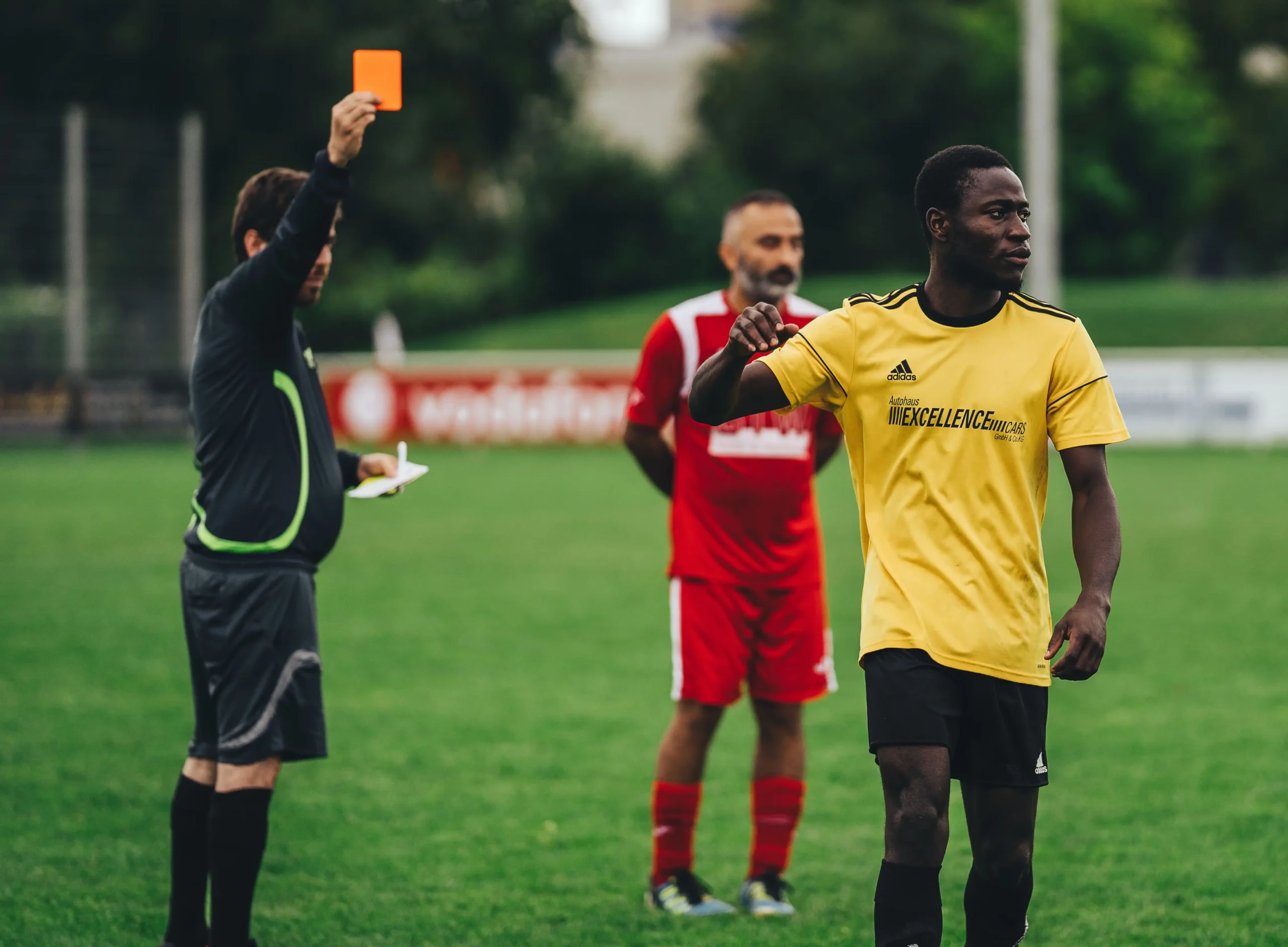
Yellow and Red Cards
Referees use cards to discipline players for serious or repeated rule violations.
Yellow Card (Caution):
A yellow card is a formal warning. Reasons include:
- Persistent fouling
- Wasting time deliberately
- Dissent, arguing with the referee
- Unsporting behaviour
- Diving (pretending to be fouled)
If a player receives two yellow cards in the same match, they automatically receive a red card and are sent off.
Red Card (Sending Off):
A red card means the player must immediately leave the pitch and cannot be replaced, their team plays with 10 players for the rest of the match. Reasons for a direct red card include:
- Serious foul play (violent or dangerous tackle)
- Violent conduct (punching, kicking an opponent)
- Spitting at anyone
- Denying an obvious goal-scoring opportunity (e.g. deliberate handball on the goal line)
- Using offensive, abusive, or insulting language
Penalty Kicks
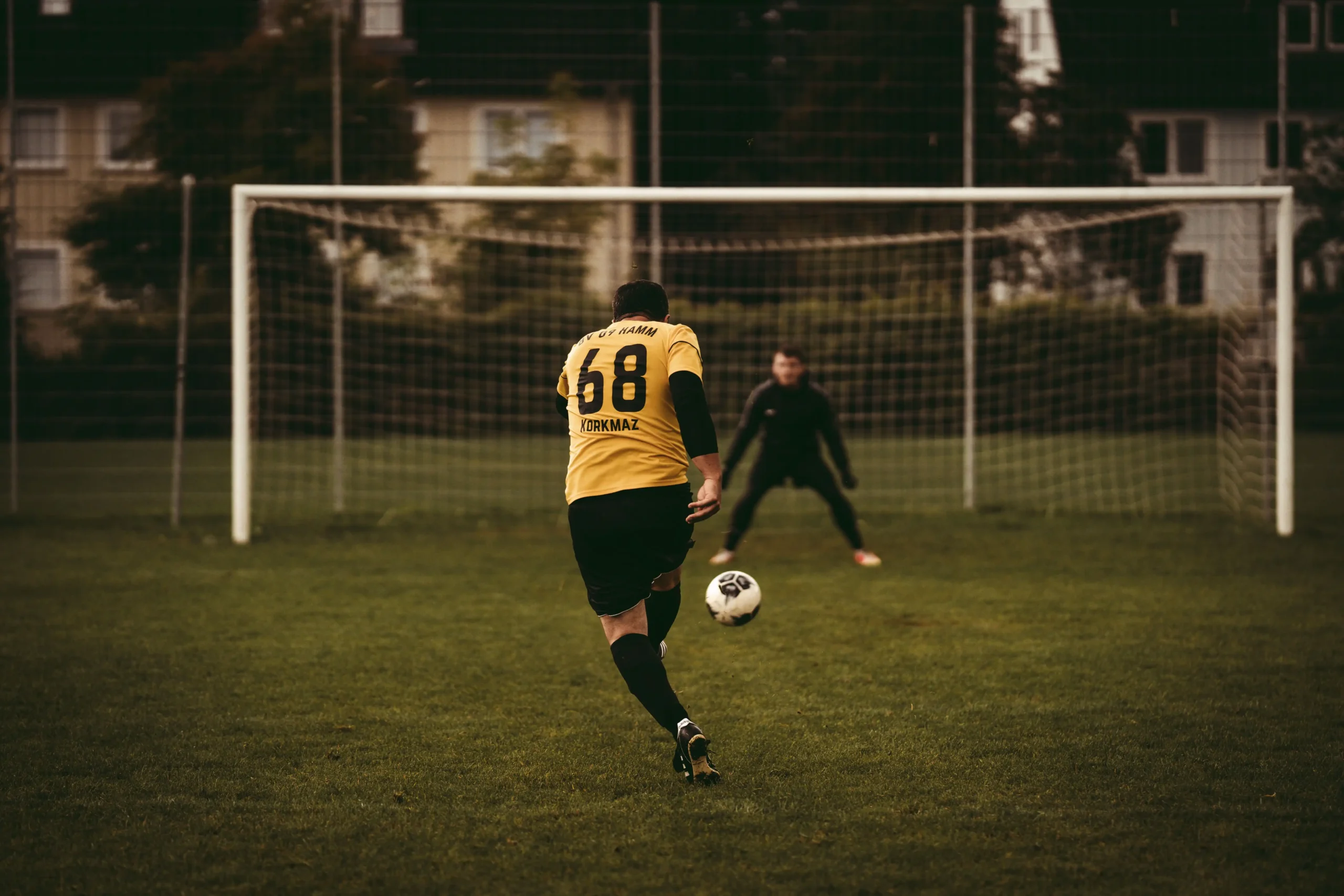
A penalty kick is awarded when a player commits a direct free kick offence inside their own penalty area.
How a penalty kick works:
- The ball is placed on the penalty spot, 11 metres (12 yards) from the goal
- Only the goalkeeper and the penalty taker are allowed in the penalty area until the ball is kicked
- The goalkeeper must stand on the goal line until the ball is kicked
- All other players must be outside the penalty area and at least 9.15 metres from the ball
If the goalkeeper saves the penalty but the ball stays in play, other players can then challenge for the rebound.
Throw-Ins
When the ball goes out of play over the sideline (touchline), the team that did not touch the ball last is awarded a throw-in.
How to take a throw-in:
- Both feet must remain on or behind the touchline
- The ball must be thrown with both hands from behind and over the head
- The ball must be released from behind the head in a continuous motion
A goal cannot be scored directly from a throw-in.
Goal Kicks and Corner Kicks
Goal Kick: When the attacking team kicks the ball out of play over the goal line (not into the goal), the defending team is awarded a goal kick. The goalkeeper places the ball anywhere inside the goal area and kicks it back into play. Opponents must stay outside the penalty area until the ball is in play.
Corner Kick: When the defending team kicks the ball out of play over their own goal line, the attacking team is awarded a corner kick. The ball is placed in the corner arc nearest to where it went out and kicked back into play. A goal can be scored directly from a corner kick.
The Goalkeeper
The goalkeeper is the only player allowed to use their hands, but only inside their own penalty area. Outside the penalty area, the goalkeeper must follow the same rules as any outfield player.
Rules specific to goalkeepers:
- Cannot hold the ball for more than 6 seconds before releasing it
- Cannot pick up the ball with their hands if a teammate deliberately passes it to them with their feet (this results in an indirect free kick for the opposition)
- Cannot be challenged by an opponent when holding the ball
Summary: Key Soccer Rules at a Glance
| Rule | Quick Explanation |
|---|---|
| Goal | Ball fully crosses goal line between posts and under bar |
| Offside | Attacker closer to goal than ball and second-last defender |
| Foul | Unfair physical action against an opponent |
| Free kick | Awarded to the opposing team after a foul |
| Penalty | Free kick from 12 yards after foul inside the box |
| Yellow card | Warning, two yellows = red card |
| Red card | Player is sent off, team plays with 10 |
| Throw-in | Ball out over sideline, both hands over head |
| Corner kick | Defending team kicks ball over own goal line |
| Goal kick | Attacking team kicks ball over defending goal line |
| Substitution | Up to 5 changes per team per match |
Frequently Asked Questions
Can a goalkeeper score a goal?
Yes. A goalkeeper can score from open play, free kicks, or even by throwing or punting the ball into the opposing goal.
What happens if a match ends in a draw?
In regular league matches, a draw stands and both teams receive one point. In knockout competitions where a winner is required, the match goes to extra time and then potentially a penalty shootout.
Can you score directly from a kickoff?
Yes. A goal scored directly from kickoff counts.
What is the VAR system?
VAR stands for Video Assistant Referee. It is a technology used in major leagues and competitions where a team of video officials in a control room reviews certain decisions, including goals, penalties, red cards, and offside calls, to help the on-field referee make the correct decision.
How many players can be on the bench?
This varies by competition. In most professional leagues, teams can name between 7 and 15 substitute players on the bench, but only 5 can actually be used during the match.