
A great soccer stadium is more than concrete and seats. It is history accumulated over decades, the collective voice of tens of thousands of supporters, the memory of legendary nights, and the sense that the ground itself has somehow absorbed every match it has ever witnessed.
Walk into Anfield when Liverpool are playing a European night. Stand under the towering tiers of Camp Nou before an El Clasico. Watch the Yellow Wall at Signal Iduna Park come to life when Borussia Dortmund score. These are experiences that go beyond sport and become something genuinely unforgettable.
This list ranks the 15 best soccer stadiums in the world based on a combination of atmosphere, history, iconic status, and the matchday experience they offer. It covers European classics and South American cathedrals alongside the modern architectural marvels that are redefining what a soccer stadium can be.
How We Ranked These Stadiums
Each stadium was assessed across four key criteria:
Atmosphere: How loud, intense, and memorable the crowd experience is during matches.
History: The significance of matches played there, the moments the ground has witnessed, and its role in the broader story of soccer.
Iconic status: How recognisable the stadium is globally and what it represents beyond its home club.
Matchday experience: The overall quality of visiting, including sightlines, design, and the sense of occasion.
1. Signal Iduna Park: Borussia Dortmund, Dortmund, Germany
Capacity: 81,365
Opened: 1974
Also known as: Westfalenstadion
Signal Iduna Park is the best soccer stadium in the world for atmosphere. Full stop.
The reason is the Yellow Wall. The south stand of Signal Iduna Park holds 24,454 standing supporters in a single, unbroken terrace, making it the largest standing area in European soccer. When those supporters are in full voice, the wall of sound generated is genuinely extraordinary. Television does not do it justice. You need to be inside the stadium to understand what it feels like.
The Yellow Wall jumps, sings, displays enormous tifos, and creates an intimidating home atmosphere that visiting players and managers have consistently described as one of the most challenging environments in world soccer. Former players have spoken about the moment they walked out and saw 24,000 people all moving in the same direction as something unlike anything else they experienced in their careers.
Signal Iduna Park also hosts the German national team for selected matches, and hosted six matches at both the 2006 World Cup and Euro 2024. It was ranked the best stadium in Europe by the research company Stasher in 2024, scoring highest across capacity, ticket pricing, and atmosphere quality.
Beyond the Yellow Wall, the ground is simply vast and beautiful. Its tiered design concentrates sound and creates a noise level that bellows out of the bowl during big matches.
Why you should visit: Experience the Yellow Wall on a Bundesliga matchday. It is the single greatest atmosphere in club soccer.
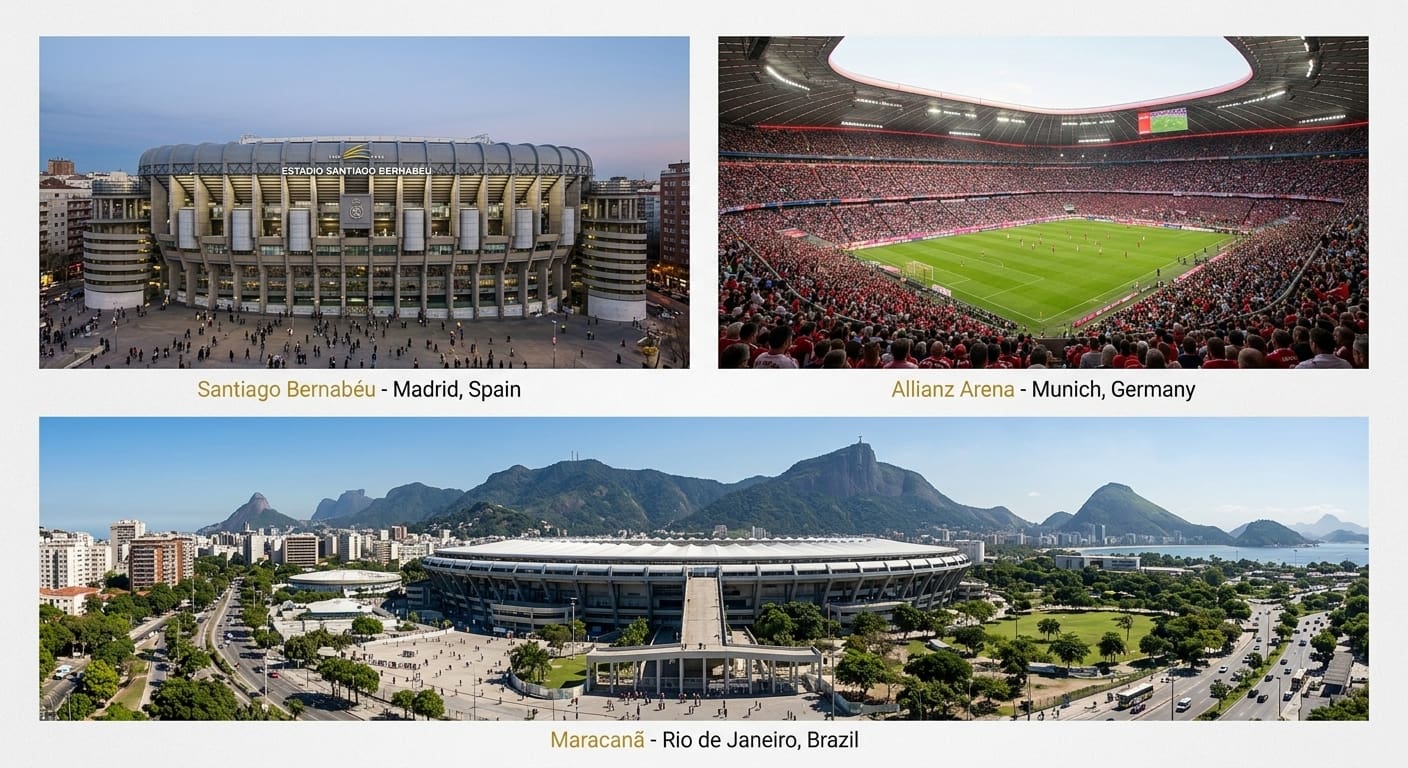
2. Santiago Bernabeu: Real Madrid, Madrid, Spain
Capacity: 81,044
Opened: 1947 (major renovation completed 2023)
Named after: Real Madrid president Santiago Bernabeu Yeste
The Santiago Bernabeu is the home of the most successful club in Champions League history, and it carries that history in every corner of the ground.
After a multi-year renovation that completed in 2023, the Bernabeu is now also one of the most technologically advanced stadiums in the world. The renovation added a retractable roof, a transformable playing surface, and a massive external facade that wraps the entire stadium in a futuristic metal mesh. At night the Bernabeu glows across the Madrid skyline.
Inside, the atmosphere on Champions League nights is electric. Real Madrid’s history of remarkable comebacks in the competition, several of them at the Bernabeu, has given the ground a mythological quality among soccer fans. Opponents arrive knowing that the Bernabeu crowd has a history of roaring their team to the brink of the impossible and somehow pushing them across.
The stadium has hosted World Cup finals, European Championships, and countless memorable nights in the greatest club competition in the world. Its combination of modern infrastructure, historic prestige, and world-class occasion make it second only to Signal Iduna Park on this list.
Why you should visit: A Champions League knockout match at the Bernabeu at night is one of the most memorable experiences in sport.
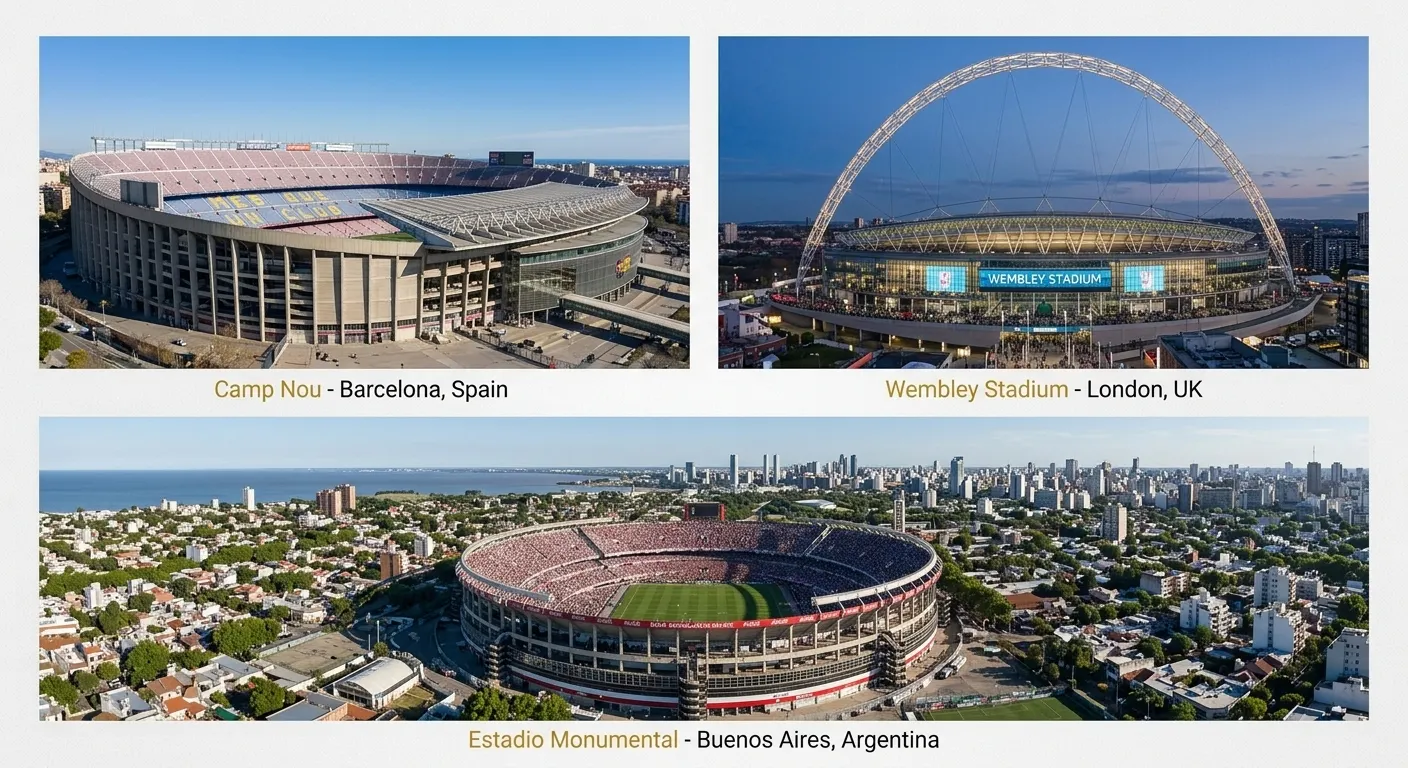
3. Camp Nou: FC Barcelona, Barcelona, Spain
Capacity: 99,354 (Europe’s largest stadium)
Opened: 1957
Current status: Under renovation and expansion
Camp Nou is the largest soccer stadium in Europe by capacity and one of the most recognisable buildings in world sport. It has been the home of FC Barcelona since 1957 and has hosted some of the greatest individual performances and greatest matches in soccer history.
What makes Camp Nou special is not just its size but what it represents. Barcelona used the stadium as a focal point of Catalan identity during the years of the Franco dictatorship, when public expressions of Catalan culture were suppressed. The club’s motto, Mes Que Un Club, More Than a Club, is not just a marketing slogan. It reflects a genuine cultural and political significance that Camp Nou embodies.
The stadium has hosted El Clasico against Real Madrid more times than any ground in the world, and those matches have produced some of the most memorable moments in the history of the sport. The noise generated by 99,000 supporters in full voice is genuinely overwhelming.
Camp Nou is currently undergoing a significant renovation that will expand its capacity further and modernise its facilities while preserving the character of the original ground.
Why you should visit: An El Clasico at Camp Nou is the most anticipated regular club match in world soccer.
4. Anfield: Liverpool FC, Liverpool, England
Capacity: 61,276
Opened: 1884
Famous section: The Kop
Anfield is the most atmospheric stadium in England and arguably the most emotionally intense soccer ground in the world. It is not the largest stadium on this list, and it is far from the most modern. But the experience of walking through the Anfield gates on matchday, hearing You’ll Never Walk Alone ring out from the entire stadium before kick-off, and feeling the roar of the Kop behind Liverpool’s goal is something that cannot be replicated anywhere else.
The Kop is the most famous single stand in English soccer, a vast covered terrace that was once standing-only and now has 12,306 seats. Even seated, the supporters in the Kop generate an atmosphere that visiting players consistently describe as the most intimidating they have ever experienced in England.
Anfield’s history is inseparable from Liverpool’s. Five European Cup and Champions League finals, countless Premier League title races, and the miraculous nights of the Istanbul era and beyond have all been launched and celebrated within these walls. The Istanbul comeback against AC Milan in 2005 was built on momentum generated at Anfield in the semi-final against Chelsea. The 2019 Champions League comeback against Barcelona, when Liverpool overturned a three-goal deficit from the first leg, is simply the most extraordinary night in the stadium’s modern history.
Why you should visit: A European night at Anfield under the lights is a bucket-list experience for any soccer fan.
5. Estadio Azteca: Mexico City, Mexico
Capacity: 83,000
Opened: 1966
World Cup appearances: 1970, 1986, 2026
The Estadio Azteca is the most historically significant soccer stadium outside of Europe. It is the only stadium in the world to have hosted three FIFA World Cups, a distinction it earned by hosting the 2026 tournament as well as the 1970 and 1986 editions.
The Azteca hosted Pele’s Brazil in 1970. It hosted the 1986 World Cup final between Argentina and West Germany. It hosted the Hand of God goal and the Goal of the Century in 1986, when Diego Maradona conjured two of the most famous moments in soccer history in the same quarter-final match against England.
The atmosphere inside the Azteca for Mexican national team matches is among the loudest and most passionate in world soccer. The stadium sits at altitude in Mexico City, adding a physical dimension to its challenges for visiting teams. Its combination of history, scale, and the raw passion of Mexican supporters make it one of the great sporting venues on earth.
Why you should visit: Mexico City is one of the great soccer cities in the world, and the Azteca is its beating heart.
6. Wembley Stadium: London, England
Capacity: 90,000
Opened: 2007 (rebuilt on site of original 1923 stadium)
Nickname: The Home of Football
Wembley is the largest soccer stadium in England and one of the most recognisable sporting venues in the world. The iconic arch that rises 133 metres above the stadium has become one of London’s most distinctive skyline features.
The original Wembley Stadium, with its famous twin towers, hosted the 1966 World Cup final where England claimed their only world title. It hosted FA Cup finals, European Cup finals, and some of the greatest moments in English soccer history. The new stadium, opened in 2007, was built on the same site and carries that history forward.
The new Wembley is the largest stadium with a roof that covers every seat, making it one of the most comfortable large stadiums in the world in terms of protection from the elements. It hosts every England home international, all FA Cup semi-finals and finals, League Cup finals, and selected Champions League finals.
Why you should visit: An FA Cup final at Wembley is one of English soccer’s most cherished traditions and one of the great matchday experiences in the sport.
7. Maracana: Rio de Janeiro, Brazil
Capacity: 78,838
Opened: 1950
Official name: Estadio Jornalista Mario Filho
The Maracana is the soul of Brazilian soccer and one of the most legendary stadiums in the history of the sport. When it opened for the 1950 World Cup it held a world record 199,854 spectators for the deciding match between Brazil and Uruguay, a figure that stands as the largest crowd ever to watch a soccer match.
That match, in which Uruguay defeated Brazil 2-1 to claim the 1950 World Cup, is known in Brazil as the Maracanazo, a word that translates roughly as the Maracana blow. It remains the defining trauma of Brazilian soccer history, a loss so devastating that the psychological impact was still being discussed and analysed more than 70 years later.
The Maracana has since witnessed Brazil’s greatest triumphs as well as its most painful defeats. It is the home of Rio de Janeiro clubs Flamengo and Fluminense and the venue for local derbies that attract passionate crowds generating extraordinary noise and colour.
Why you should visit: The samba rhythms, the colour, and the passion of a Flamengo home match at the Maracana represent soccer as a cultural and spiritual event.
8. Allianz Arena: Bayern Munich, Munich, Germany
Capacity: 75,000
Opened: 2005
The Allianz Arena is one of the most architecturally striking sporting buildings in the world. Its exterior is covered in inflated EFTE plastic panels that can be illuminated in different colours depending on the team playing inside. When Bayern Munich play, the entire exterior glows in deep red. When the German national team uses the stadium, it turns white. When former tenants 1860 Munich played there, it lit up in blue.
The visual spectacle of approaching the Allianz Arena on matchday is unlike almost anything else in sport. The glowing stadium sitting in the Munich evening is genuinely beautiful, and the experience inside matches the exterior’s promises. Bayern Munich’s supporters create an intense home atmosphere in a stadium that uses its curved bowl design to channel and amplify sound.
The Allianz Arena hosted the 2012 Champions League final and six matches during the 2006 World Cup. It is also the venue where Chelsea famously defeated Bayern Munich on penalties in the 2012 final, beating them in their own stadium.
Why you should visit: The approach to the Allianz Arena on matchday, with the illuminated exterior glowing across Munich, is one of the great visual spectacles in world sport.
9. San Siro: Milan, Italy
Capacity: 80,018
Opened: 1926
Official name: Stadio Giuseppe Meazza
San Siro is one of the most dramatic and atmospheric stadiums in the world, shared by the two great Milan clubs, AC Milan and Inter Milan. Built in 1926 and expanded multiple times since, its towering spiral ramps on the outside and the circular design that creates an almost enclosed bowl on the inside make it unlike any other ground in European soccer.
The stadium has hosted Champions League finals, World Cup matches, and some of the most significant matches in Italian soccer history. The noise generated during a Milan derby, when both sets of supporters pack the ground to capacity, is described by players and fans alike as one of the most overwhelming atmospheres in world soccer.
San Siro has been at the centre of debate in recent years as both clubs have discussed building a new stadium. But for now, it remains one of the truly great soccer grounds.
Why you should visit: A Milan derby at San Siro is one of the most intense and atmospheric experiences in European club soccer.
10. Old Trafford: Manchester United, Manchester, England
Capacity: 74,879
Opened: 1910
Nickname: The Theatre of Dreams
Old Trafford is the most famous soccer stadium in England outside Wembley and one of the most recognisable in the world. Built in 1910 and home to Manchester United for over a century, it carries a history that encompasses the club’s entire rise from regional club to global brand.
Sir Matt Busby managed from Old Trafford. Bobby Charlton played there for two decades. Eric Cantona turned the ground into his own theatre of personal reinvention. Cristiano Ronaldo announced himself to the world there. Sir Alex Ferguson achieved 26 years of dominance from the Old Trafford dugout.
The stadium has witnessed European Cup finals, FA Cup finals, and countless memorable nights in English and European soccer. Despite recent discussions about renovation or replacement, Old Trafford retains a unique character that more modern grounds struggle to match.
Why you should visit: Old Trafford on a European night remains one of English soccer’s great experiences, its history palpable in every corner of the ground.
11. La Bombonera: Boca Juniors, Buenos Aires, Argentina
Capacity: 54,000
Opened: 1940
Nickname: The Chocolate Box
La Bombonera is the most intimidating soccer ground in South America and one of the most intense atmospheres in world soccer. The nickname, meaning The Chocolate Box, refers to the distinctive rectangular shape of the stadium, which has three towering stands and one smaller stand creating an unusual and claustrophobic enclosed space that traps and amplifies noise.
The engineering of the stadium means it actually vibrates during matches when the crowd jumps in unison. Players and visitors frequently describe feeling the physical vibration of the stands as tens of thousands of Boca Juniors supporters move together. This is not a metaphor. The ground shakes.
Boca Juniors vs River Plate, the Superclasico, is played at La Bombonera when Boca host, and it is widely considered the most intense derby atmosphere in world soccer. The confined space, the noise, and the passion of Argentine soccer culture combine to create something genuinely unlike any other stadium experience in the world.
Why you should visit: If you can get a ticket to a Superclasico at La Bombonera, you should take it without hesitation.
12. SoFi Stadium: Los Angeles, USA
Capacity: 70,000 (expandable to 100,000)
Opened: 2020
Cost: Approximately $6 billion
SoFi Stadium is the most expensive stadium ever built and a genuinely stunning piece of architecture. Located in Inglewood, California, it is the home of the Los Angeles Rams and Los Angeles Chargers NFL teams but has hosted major soccer events including matches at the 2026 World Cup.
The stadium features a translucent roof canopy that protects all seats from weather while allowing natural light. Inside, a massive dual-sided 4K video board runs the length of the field and is visible from most seats in the stadium. The sightlines are exceptional and the facilities are the most advanced of any stadium in the world.
SoFi represents a genuinely new vision for what a stadium can be, one built from scratch as a technology-first venue that uses every tool available to enhance the experience of watching sport. It lacks the history of the European and South American grounds on this list, but as a modern matchday experience it is unmatched.
Why you should visit: SoFi is a glimpse into what the future of stadium design looks like, and the sheer scale and technology inside are genuinely impressive.
13. Estadio Monumental: River Plate, Buenos Aires, Argentina
Capacity: 84,567
Opened: 1938
Nickname: El Monumental
River Plate’s Estadio Monumental is the largest stadium in South America and the home of one of Argentina’s most successful and historically significant clubs. It is also the national stadium of Argentina, having hosted the 1978 World Cup final in which Argentina defeated the Netherlands 3-1.
The atmosphere for River Plate matches and Argentine national team games is among the most passionate in the world. The Monumental fills with red and white banners, fireworks, and the sound of Argentine soccer culture in full voice. Walking into the Monumental when 84,000 Argentine fans are singing is an experience that leaves a permanent impression.
Why you should visit: Experiencing Argentine soccer culture in South America’s largest stadium is genuinely unlike anything available in European soccer.
14. Estadio Akron: Chivas de Guadalajara, Guadalajara, Mexico
Capacity: 48,000
Opened: 2010
The Estadio Akron, also known as the Omnilife Stadium, is one of the most visually distinctive stadiums in the Americas. Its exterior features a volcano-inspired design with distinctive porthole-style windows that give it an appearance unlike any other soccer ground in North America.
The stadium sits at the foot of the Cerro de la Silla mountain outside Guadalajara, giving it one of the most dramatic natural settings of any soccer venue in the world. The views from the upper sections on a clear day are genuinely breathtaking, with the mountain rising directly behind the stadium.
It hosted matches at the 2026 World Cup, introducing it to a global audience that was largely unfamiliar with one of Mexico’s great soccer venues.
Why you should visit: The combination of unique architecture and the dramatic natural setting of the Cerro de la Silla makes this one of the most visually spectacular stadium experiences anywhere.
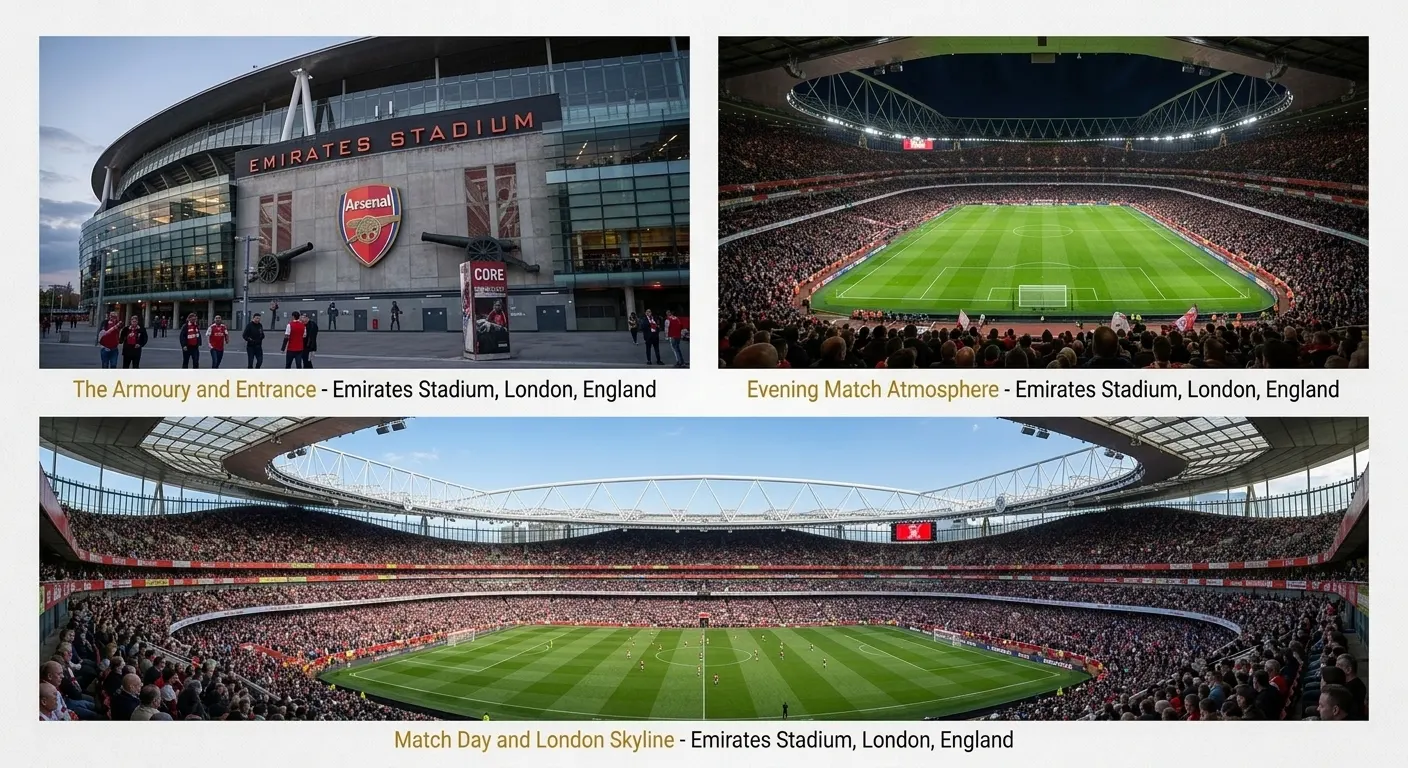
15. Emirates Stadium: Arsenal, London, England
Capacity: 60,704
Opened: 2006
Nickname: The Home of Football (shared title with Wembley)
Arsenal’s Emirates Stadium is one of the most well-designed modern soccer grounds in England, opened in 2006 when the club relocated from their historic but capacity-limited Highbury ground. The stadium was purpose-built for soccer and the sightlines from every seat are excellent.
The Emirates lacks the history of Anfield or the raw atmosphere of grounds like Signal Iduna Park or La Bombonera, but it is a fine modern stadium that provides an excellent matchday experience. Arsenal’s growing success under Mikel Arteta and their return to regular Champions League football has increased the electric quality of big European nights there.
The stadium sits within walking distance of Highbury, and the area around Arsenal on matchday has a genuine buzz that reflects one of English soccer’s oldest and most passionate supporter communities.
Why you should visit: North London on Arsenal matchday has a genuine atmosphere and the Emirates provides one of the cleaner, more comfortable large stadium experiences in English soccer.
Quick Reference: All 15 Stadiums
| Rank | Stadium | Club | Country | Capacity |
|---|---|---|---|---|
| 1 | Signal Iduna Park | Borussia Dortmund | Germany | 81,365 |
| 2 | Santiago Bernabeu | Real Madrid | Spain | 81,044 |
| 3 | Camp Nou | FC Barcelona | Spain | 99,354 |
| 4 | Anfield | Liverpool | England | 61,276 |
| 5 | Estadio Azteca | National/Clubs | Mexico | 83,000 |
| 6 | Wembley Stadium | England national | England | 90,000 |
| 7 | Maracana | Flamengo/Fluminense | Brazil | 78,838 |
| 8 | Allianz Arena | Bayern Munich | Germany | 75,000 |
| 9 | San Siro | AC Milan/Inter | Italy | 80,018 |
| 10 | Old Trafford | Manchester United | England | 74,879 |
| 11 | La Bombonera | Boca Juniors | Argentina | 54,000 |
| 12 | SoFi Stadium | Rams/Chargers/Soccer | USA | 70,000 |
| 13 | Estadio Monumental | River Plate | Argentina | 84,567 |
| 14 | Estadio Akron | Chivas Guadalajara | Mexico | 48,000 |
| 15 | Emirates Stadium | Arsenal | England | 60,704 |
Frequently Asked Questions
What is the largest soccer stadium in the world?
The Rungrado 1st of May Stadium in Pyongyang, North Korea has a claimed capacity of 114,000 and is technically the largest stadium in the world, though it is rarely open to international visitors. Among regularly used and accessible soccer stadiums, the Estadio Monumental in Buenos Aires is the largest in South America at 84,567, while Camp Nou in Barcelona remains the largest in Europe at 99,354.
Which soccer stadium has the best atmosphere?
Signal Iduna Park in Dortmund, Germany is widely considered to have the best atmosphere in world soccer, primarily because of the Yellow Wall, the 24,454-capacity standing terrace that creates an extraordinary wall of sound and movement. Anfield in Liverpool and La Bombonera in Buenos Aires are also frequently cited as producing exceptional atmospheres.
What is the most famous soccer stadium in the world?
This depends on the criteria used, but Camp Nou, the Santiago Bernabeu, and Anfield are arguably the three most globally recognised soccer stadiums. Wembley is the most iconic stadium in English soccer history and one of the most famous venues in any sport.
Which stadium has hosted the most World Cup matches?
The Estadio Azteca in Mexico City is the only stadium to have hosted three separate World Cups, in 1970, 1986, and 2026. It is also the only stadium to have hosted two World Cup finals.
Is Old Trafford still one of the best stadiums in the world?
Old Trafford remains one of the most historically significant and globally recognised soccer stadiums in the world. However its facilities have aged compared to more modern grounds, and Manchester United have been discussing renovation or replacement options for several years. It still ranks among the top soccer stadiums for history and iconic status.
What is the most expensive stadium ever built?
SoFi Stadium in Inglewood, California, home of the Los Angeles Rams and Chargers and a 2026 World Cup venue, cost approximately $6 billion to build and is the most expensive stadium ever constructed. Its ultra-modern facilities, translucent roof canopy, and enormous dual-sided video board represent the current peak of stadium technology.