
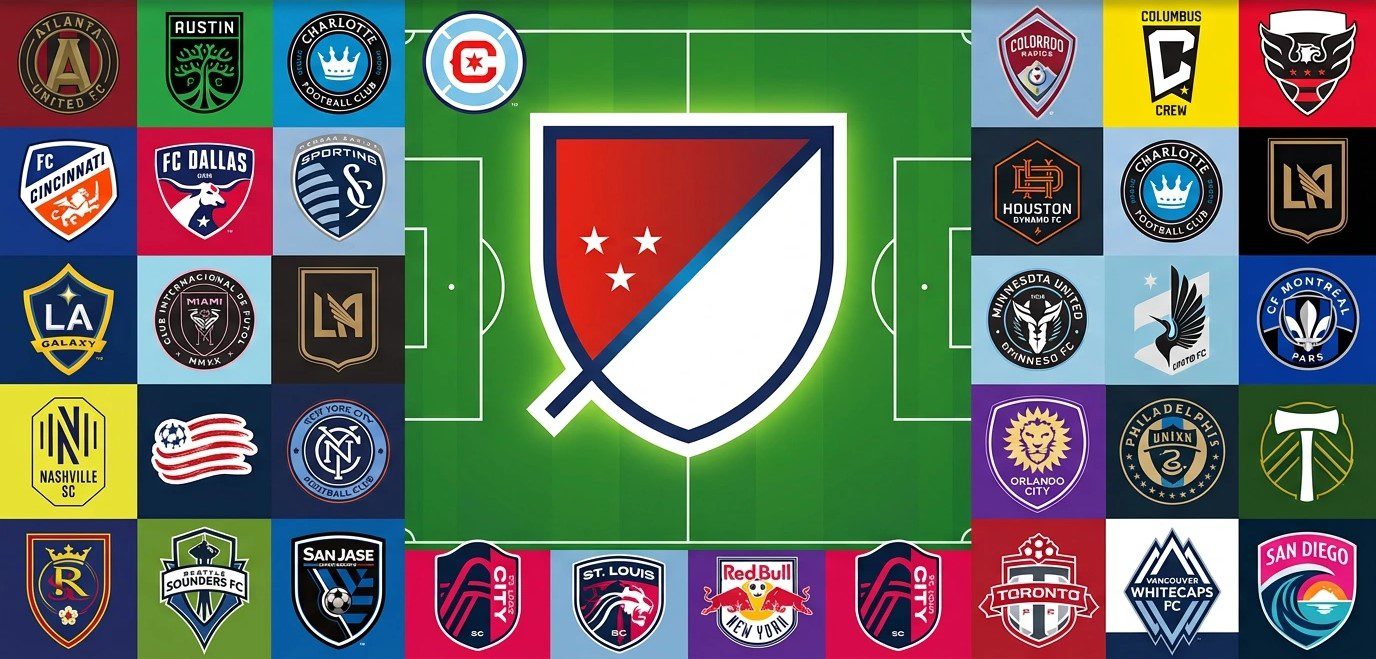
Major League Soccer is the top professional soccer league in the United States and Canada, and it has transformed beyond recognition since its humble beginnings 30 years ago.
In 1996, MLS launched with ten teams, modest crowds, and a country that was still largely indifferent to the sport. In 2026, the league has 30 clubs, average attendances that rival many European leagues, global stars playing in its stadiums every week, and the momentum of co-hosting the FIFA World Cup driving unprecedented public interest in American soccer.
If you are new to MLS, wondering what it is and how it works, or just trying to understand why so many people are suddenly talking about American soccer, this guide covers everything you need to know.
What is MLS?
MLS stands for Major League Soccer. It is the top division of the American soccer pyramid, recognised by both the United States Soccer Federation and Canada Soccer as the country’s premier professional soccer competition.
Unlike most major European soccer leagues where clubs are independently owned and compete for promotion and relegation, MLS operates as a single-entity structure. This means the league itself retains certain central controls over player contracts and financial operations, a model borrowed from other North American professional sports leagues like the NFL and NBA.
The league is headquartered in New York City and is overseen by Commissioner Don Garber, who has held the role since 1999 and has been the central figure behind the league’s long-term growth strategy.
In 2026, MLS is in its 31st season and celebrating the moment when American soccer finally arrived on the world stage.
The History of MLS
How It Started: 1993 to 1996
The story of MLS begins not in a boardroom but in a negotiating room. When FIFA awarded the United States hosting rights for the 1994 World Cup, one of the conditions attached to the bid was that the US would establish a professional Division 1 soccer league. MLS was officially incorporated in December 1993 to fulfil that commitment.
The league’s first match was played on April 6, 1996, and the inaugural ten teams were split into two conferences. DC United won the first ever MLS Cup at the end of that inaugural season, establishing themselves as the dominant force in the league’s opening era.
Near Collapse: 2001 to 2002
By 2001, things looked very different. Struggling attendances, financial losses, and poor franchise placement decisions led the league to take the drastic step of contracting two teams. The Tampa Bay Mutiny and the Miami Fusion were folded before the 2002 season, leaving MLS with just ten clubs again.
It was the lowest moment in the league’s history and many observers believed MLS would not survive. The decision to hold on through that crisis rather than fold entirely proved to be the turning point that made everything which followed possible.
The Comeback: 2005 to 2015
Starting from 2005, MLS began a sustained expansion phase that nearly doubled the size of the league over a decade. New clubs joined from cities including Real Salt Lake, Toronto, Seattle, Philadelphia, Vancouver, Portland, and Montreal.
The single most important rule change in the league’s history also came in this period. The Designated Player Rule, introduced in 2007 and often called the Beckham Rule, allowed MLS clubs to sign one player outside the league’s strict salary cap restrictions. The rule was created specifically to enable the signing of David Beckham by LA Galaxy, and it transformed the league’s ability to attract global stars.
Beckham’s arrival proved that a genuine soccer icon could succeed and sell tickets in the United States, and it opened the door for a long line of international stars who followed him to MLS in the years that followed.
The Star Power Era: 2007 Onwards
Following Beckham, a series of internationally recognised names chose MLS as their destination in the final chapters of their careers. Thierry Henry joined New York Red Bulls in 2010. Kaka arrived at Orlando City in 2015. Zlatan Ibrahimovic joined LA Galaxy in 2018. Frank Lampard played for New York City FC. Bastian Schweinsteiger spent three seasons with Chicago Fire.
Each arrival generated significant media coverage and brought new audiences to the league, but none compared to what happened in the summer of 2023.
The Messi Effect: 2023 to Present
When Lionel Messi, widely regarded as the greatest soccer player in history, chose to join Inter Miami CF in the summer of 2023, it was a genuinely historic moment for American soccer. The level of global media coverage, the surge in Inter Miami merchandise sales, the transformation of the team’s matchday atmosphere, and the broader impact on MLS viewership numbers were unprecedented.
Messi won the MLS Cup with Inter Miami in 2025, becoming the first truly global superstar to win the league’s championship. Inter Miami opened their stunning new stadium, Nu Stadium, in April 2026, giving Messi and his teammates a worthy home for the final chapter of the greatest soccer career in history.

How MLS Works
The Teams
In 2026, MLS has 30 clubs split across two conferences:
Eastern Conference (15 teams)
Atlanta United, CF Montreal, Charlotte FC, Chicago Fire, FC Cincinnati, Columbus Crew, D.C. United, Inter Miami CF, Nashville SC, New England Revolution, New York City FC, New York Red Bulls, Orlando City, Philadelphia Union, Toronto FC
Western Conference (15 teams)
Austin FC, Colorado Rapids, FC Dallas, Houston Dynamo, LA Galaxy, LAFC, Minnesota United, Portland Timbers, Real Salt Lake, San Jose Earthquakes, Seattle Sounders, Sporting Kansas City, St. Louis City SC, Vancouver Whitecaps, Club de Foot Montreal
The 2026 season is notable as the first in over 20 years with no new expansion team joining the league. MLS club valuations have grown dramatically, with an average valuation of $721 million per club according to Sportico’s February 2026 report, up 31 percent from their first valuations in 2021. Five clubs are now valued at more than $1 billion.
The Regular Season
The 2026 MLS regular season runs from February 21 to November 7, with each of the 30 clubs playing 34 matches, 17 at home and 17 away. The final matchday of the regular season is called Decision Day, when all remaining matches are played simultaneously to prevent any team from having an unfair advantage.
Points are awarded in the standard soccer format: three points for a win, one for a draw, zero for a loss. Teams are ranked within their conference by total points, with goal difference and goals scored used as tiebreakers.
The MLS Cup Playoffs
Unlike European leagues where the team that accumulates the most points across the season wins the title, MLS determines its champion through a post-season playoff tournament. This model follows the tradition of North American professional sports and creates additional end-of-season drama.
The top nine teams from each conference qualify for the MLS Cup Playoffs, giving 18 of the 30 clubs a path to the championship. The playoffs run from November to December, with the MLS Cup final typically taking place in mid-December.
The Supporters’ Shield is awarded separately to the team that finishes first in the overall regular-season standings across both conferences, recognising the best regular-season performance regardless of what happens in the playoffs.
The Designated Player Rule
The Designated Player Rule allows each MLS club to sign up to three players outside the constraints of the league’s salary cap. These players, known as Designated Players or DPs, can be paid market rate salaries with only a portion of their wage counting against the salary cap.
This rule has been the key mechanism through which MLS clubs have attracted international stars. Lionel Messi, like Beckham, Thierry Henry, and Zlatan Ibrahimovic before him, came to MLS as a Designated Player.
How MLS Differs from European Leagues
Understanding MLS becomes easier when you know how it differs from the European model most soccer fans are familiar with.
| Feature | MLS | European Leagues |
|---|---|---|
| Promotion/Relegation | None | Yes in most leagues |
| Salary Cap | Yes | No |
| Season Timing | February to December | August to May |
| Champion Determined By | Playoff tournament | League standings |
| Team Ownership | Single-entity elements | Fully independent clubs |
| Conferences | East and West | No conferences |
The absence of promotion and relegation is the most significant structural difference. In MLS, finishing last in the league has no consequences in terms of which division you play in next season. This is fundamentally different from the European model and remains a topic of debate among American soccer fans, with some arguing promotion and relegation would increase the competitiveness and drama of the regular season.
The 2026 Season: A Historic Year
The 2026 MLS season is the most watched in the league’s history, benefiting enormously from the World Cup effect. With the tournament hosted across American cities over the summer, millions of new fans who discovered or rediscovered soccer during the World Cup have continued following MLS as the club season resumed.
Nashville SC led the Eastern Conference standings through much of the mid-season stretch before Inter Miami, powered by Messi, climbed into contention. In the Western Conference, Vancouver Whitecaps and San Jose Earthquakes have competed closely for top spot throughout the season.
All MLS matches are available on Apple TV, following a landmark broadcasting deal that made MLS the first major American sports league to put all its games on a single streaming platform. From 2026 the MLS Season Pass arrangement changed so that every match is now included with a standard Apple TV subscription at no additional cost, removing the separate pass fee that existed in previous seasons.
The Biggest MLS Clubs
LA Galaxy
LA Galaxy are the most successful club in MLS history with five MLS Cup titles. They were the club that signed David Beckham in 2007, transforming American soccer’s global profile at a stroke. Based in Los Angeles, they draw some of the largest attendances in MLS and have a passionate supporter base that has followed the club through its highs and lows over three decades.
Inter Miami CF
Inter Miami are the most talked-about club in MLS history since the arrival of Lionel Messi in 2023. Founded in 2020 by David Beckham, the club went from a mid-table side to MLS Cup champions in 2025 with Messi leading the way. Their new Nu Stadium, opened in 2026, is among the finest soccer-specific venues in North America.
Seattle Sounders
Seattle Sounders are consistently among the best-supported clubs in MLS, regularly drawing crowds of over 40,000 to their matches at Lumen Field. They have won multiple MLS Cup titles and have a supporter culture that rivals anything in the league for passion and organisation.
Atlanta United
Atlanta United set all-time MLS attendance records after joining the league in 2017, drawing crowds of over 70,000 to matches at Mercedes-Benz Stadium. Their rapid rise from expansion club to MLS Cup winners demonstrated how a combination of smart management, a strong fanbase, and the right market could transform a club’s fortunes in a short time.
LAFC
Los Angeles FC are the modern rival to LA Galaxy in the city of Los Angeles, having joined MLS in 2018. LAFC play at the Banc of California Stadium, one of the most visually impressive soccer-specific stadiums in the world, and have quickly built a competitive on-field reputation alongside a passionate supporter base.
MLS and American Soccer’s Future
The World Cup Legacy
The 2026 World Cup had a transformative effect on American soccer that will be felt for years. Hosting 11 American cities and bringing the world’s greatest players to American stadiums introduced millions of people to the sport at the highest level. MLS is the direct beneficiary of that surge of interest, with viewing figures, attendances, and youth participation all showing growth in the months after the tournament.
The Calendar Change
MLS has announced plans to transition from its current spring-to-autumn calendar to a summer-to-spring calendar starting from the 2027-28 season, aligning it more closely with European leagues. A shortened 14-match sprint season will be played in early 2027 as a transition arrangement. This change has been discussed for years and represents a significant structural shift that will bring MLS into better alignment with the global soccer calendar.
Youth Development
One of the most important long-term investments in American soccer is the growth of MLS academy programs. Every MLS club operates a youth development academy, and the pipeline of American talent reaching professional level has improved significantly over the past decade. Players developed through MLS academies have gone on to play for the US national team and sign contracts with top European clubs, representing a genuine shift in the quality of homegrown American soccer talent.
Frequently Asked Questions
How many teams are in MLS in 2026?
MLS has 30 clubs in 2026, split evenly between the Eastern Conference and Western Conference with 15 teams in each.
Who won the most recent MLS Cup?
Inter Miami CF won the 2025 MLS Cup, their first ever championship, with Lionel Messi leading the team to the title. It was a historic moment for American soccer, the world’s greatest player winning the league’s highest honour.
Is MLS as good as European soccer?
MLS is not yet at the same overall quality level as the Premier League or La Liga, but the gap has narrowed significantly over the past decade. The best MLS players are competitive with mid-table European league players, and the league’s investment in youth development is producing a new generation of American talent capable of competing at the highest global levels.
How do I watch MLS in 2026?
All MLS matches in 2026 are available on Apple TV, included with a standard Apple TV subscription. Selected matches also air on FOX and FS1, which are available through traditional cable and most live TV streaming services.
Does MLS have promotion and relegation?
No. MLS does not have a promotion and relegation system. Finishing at the bottom of the standings has no consequences for which division a club plays in the following season. This is one of the key structural differences between MLS and most European soccer leagues.
What is the Designated Player Rule?
The Designated Player Rule, also known as the Beckham Rule, allows each MLS club to sign up to three players outside the league’s salary cap constraints. These players can be paid market rate wages, with only a portion of their salary counting against the cap. The rule was introduced in 2007 and has been responsible for bringing many international stars to MLS.
When does the MLS season run?
The 2026 MLS regular season runs from February 21 to November 7, with the playoffs extending through to December. From the 2027-28 season MLS plans to transition to a summer-to-spring calendar more aligned with European leagues.